
Saturn has spent more than forty years being known for one specific oddity. A six sided storm, wrapped tightly around its north pole, so geometrically clean that when Voyager first photographed it in 1980, scientists assumed something was wrong with the camera. Nothing was wrong. Saturn really does have a hexagon for a weather system.
Now it has a sibling, and it does not match.
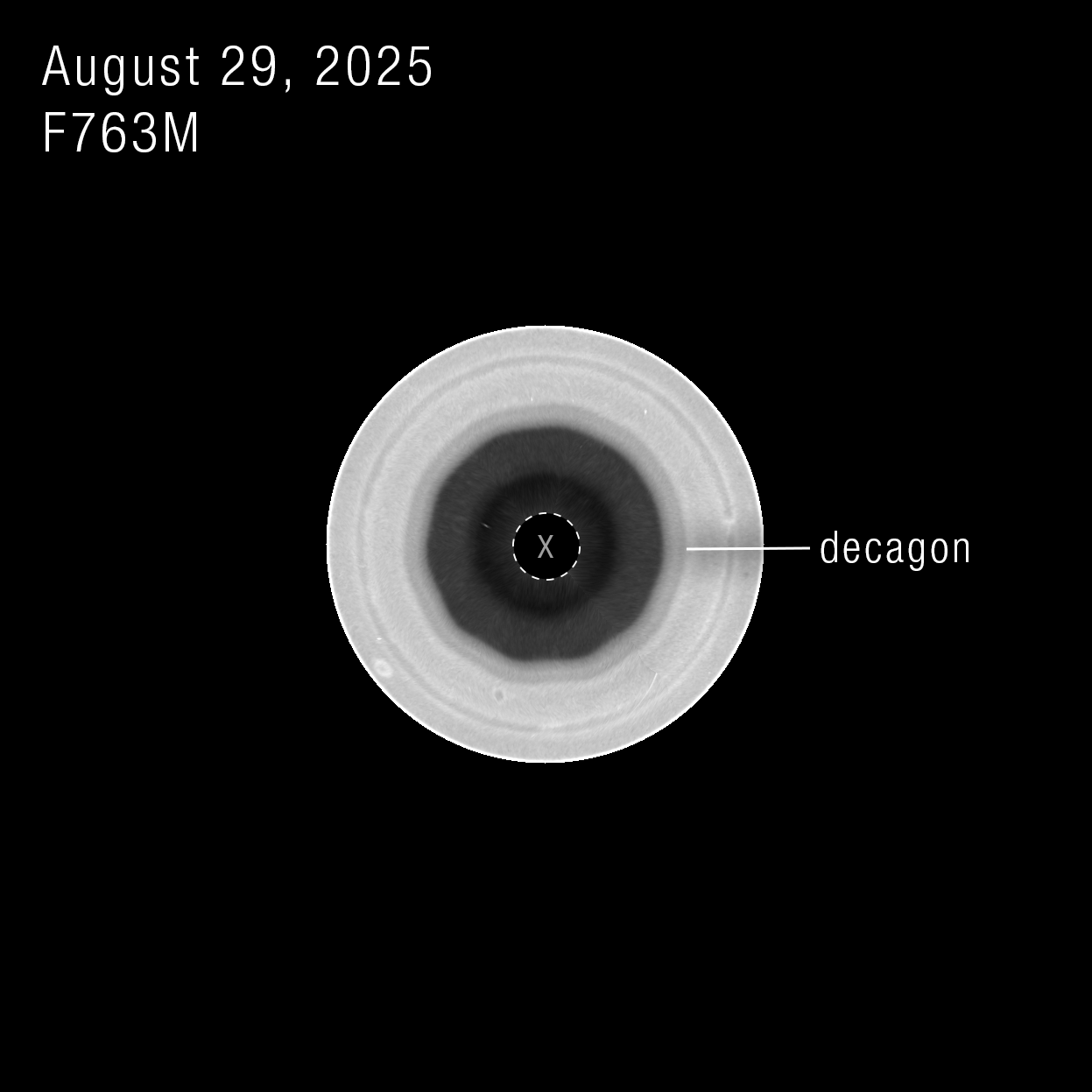
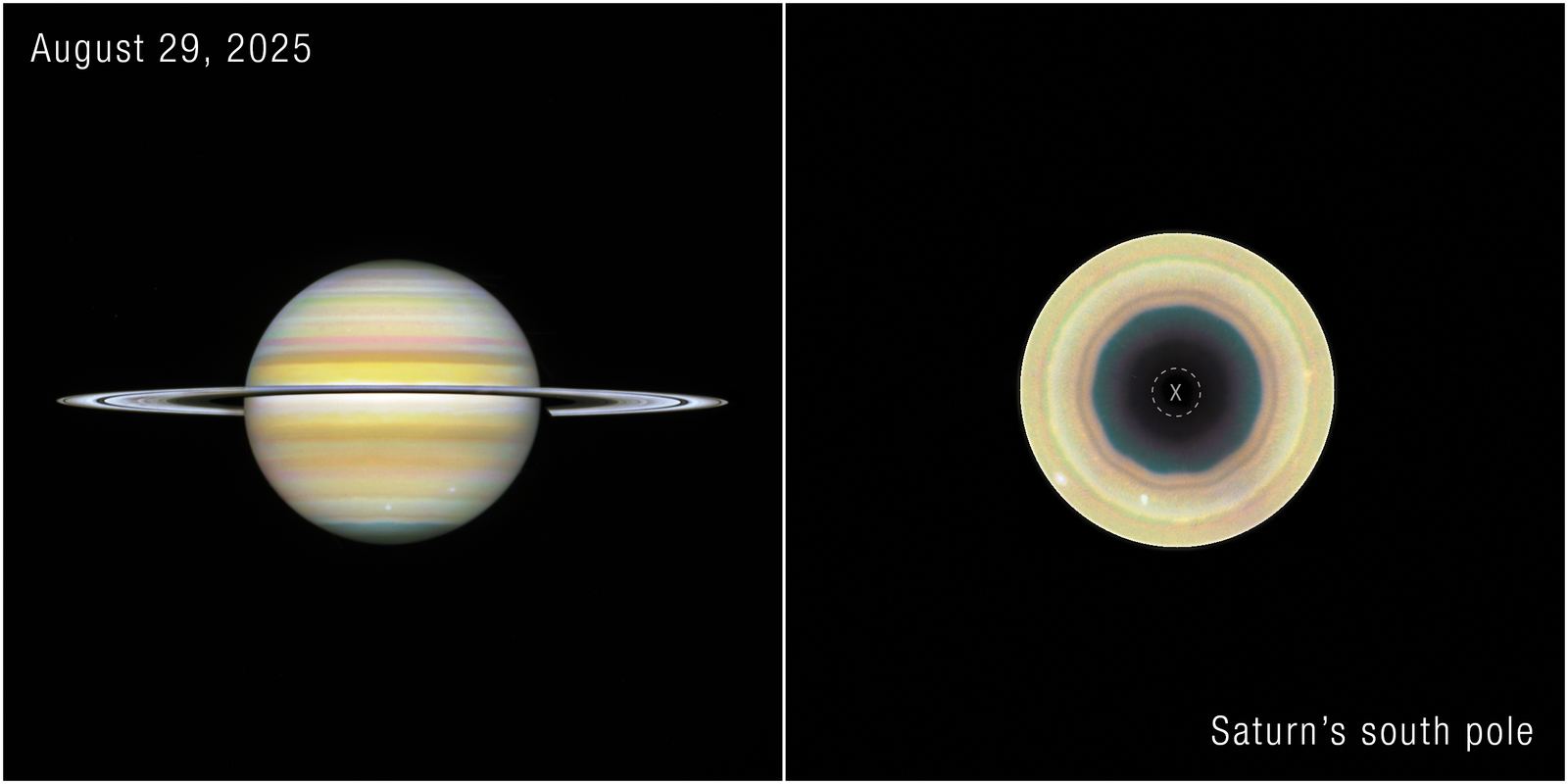
Using the Hubble Space Telescope, a team led by Agustin Sanchez Lavega at the University of the Basque Country has confirmed a second, entirely separate geometric storm at Saturn’s south pole. This one has ten sides. Researchers are calling it the decagon, and unlike its northern counterpart, nobody has ever seen it before.
Saturn’s Polar Patterns at a Glance
| Feature | Northern Hexagon | Southern Decagon |
|---|---|---|
| Number of sides | 6 | 10 |
| First observed | Voyager, 1980 to 1981 | Hubble, confirmed 2025 |
| Confirmed by | Voyager, later Cassini | Hubble Space Telescope, OPAL program |
| Approximate width | Wide enough to fit nearly 4 Earths | Still being measured |
| Status | Persistent for over 40 years | New, still strengthening |
| Publishing journal | Not applicable | Science Advances, September 2026 |
A Storm That Was Not Supposed to Exist
For decades, planetary scientists assumed Saturn’s north and south poles should behave the same way. The planet is close to symmetrical, the two poles receive comparable sunlight over a Saturn year, and the same deep jet stream dynamics govern both hemispheres.
So when Cassini spent thirteen years orbiting Saturn between 2004 and 2017, a mission comparable in scope to MESSENGER’s own years spent mapping Mercury, capturing detailed imagery of both poles, scientists expected to eventually find a southern hexagon to match the northern one.
They found nothing. The southern pole showed no persistent geometric pattern of any kind, for the entire span of the Cassini mission.
That changed only when Saturn’s slow, nearly thirty Earth year orbit brought its southern hemisphere back into view from Earth in recent years. Ground based astronomers, including amateur observers Trevor Barry and Jean Paul Oger, began noticing a faint, undulating band near the south pole in images submitted to a public observation archive in 2024.
By 2025, the pattern had sharpened enough that Hubble was pointed directly at it, and the images taken on August 29, 2025 confirmed what the ground based data had hinted at. A distinct, ten sided wave, wrapped around Saturn’s south pole, extending through multiple layers of the atmosphere rather than sitting only at the cloud tops.
“We’ve never seen anything quite like this in Saturn’s southern hemisphere,” said Amy Simon, one of the researchers on the study and principal investigator of Hubble’s Outer Planet Atmospheres Legacy program, in NASA’s announcement. “The northern hexagon has been there every time we’ve looked for more than 40 years. This feature is different. It appears to be strengthening, giving us the rare opportunity to watch a giant atmospheric pattern develop.”
That last point is what separates this discovery from almost anything else astronomers get to study on a gas giant. Most of what we know about Saturn’s atmosphere comes from features that were already fully formed by the time we found them.
This time, scientists appear to be watching something build in close to real time, and they do not yet know whether it will settle into a stable, decades long shape the way the hexagon did, or whether it will dissolve back into ordinary turbulence within a few years.
Why a Planet’s Atmosphere Would Form a Polygon at All
The idea of a storm having straight sides sounds like it should be impossible. Storms are supposed to be round. But Saturn’s polygons are not clouds shaped like a hexagon or a decagon in the way a cloud might resemble a rabbit. They are the visible trace of a jet stream, a fast moving current of atmospheric gas, and jet streams do not have to flow in a circle.
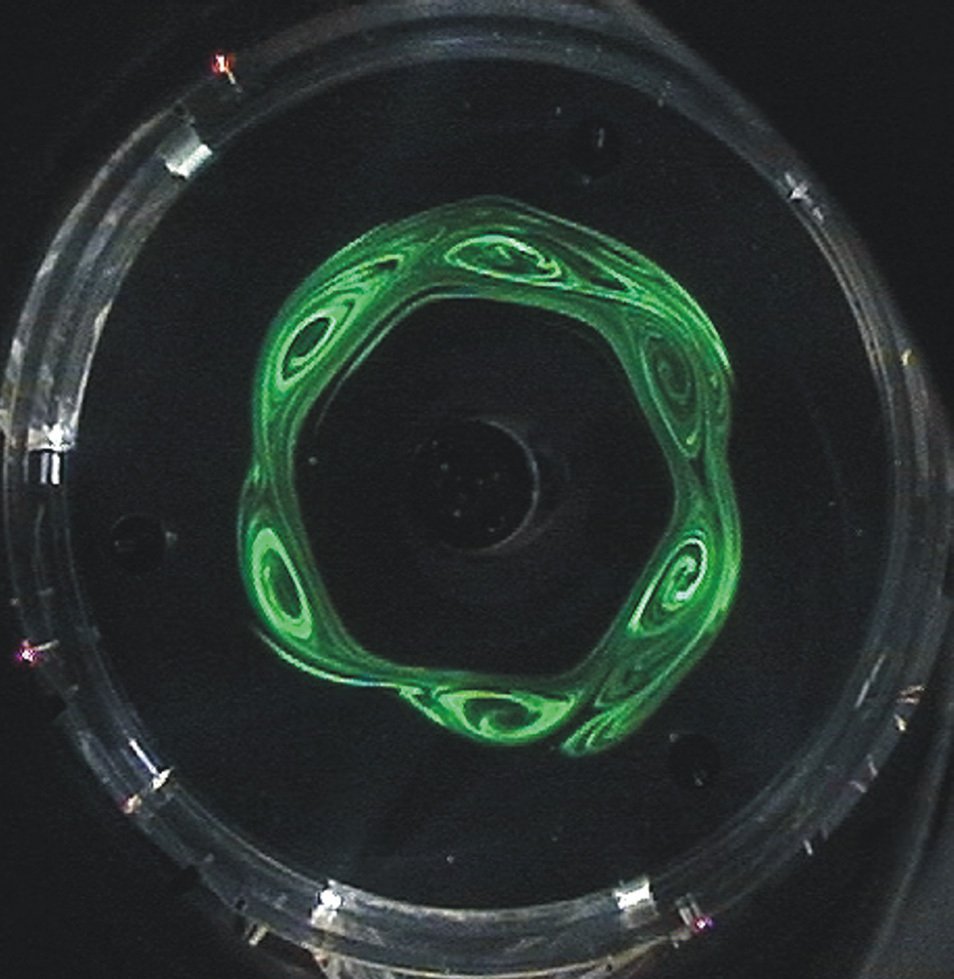
Researchers first got a physical sense of why in a laboratory at the University of Oxford, well before the southern pattern was ever detected. Physicists placed a rotating cylinder of water on a slowly spinning table, then added a smaller ring inside it that spun faster than the cylinder around it, creating a miniature artificial jet stream that they tracked with dye.
When the difference in rotation speed between the inner ring and the outer cylinder reached a certain threshold, the circular jet stream became unstable. Small eddies formed along its edges, grew larger, and eventually forced the flowing water into a straight sided polygon. By adjusting the rotation speeds, the team could produce triangles, squares, ovals, and hexagons on demand. Saturn’s actual hexagon, they concluded, is very likely the atmosphere’s jet stream having settled into exactly the rotation difference that produces six sides.
Saturn’s northern hexagon itself is enormous. Each of its six sides stretches roughly 14,500 kilometers, making the whole shape wide enough to fit nearly four Earths inside it, and the jet stream that traces its outline moves at around 320 kilometers per hour. It reaches roughly 300 kilometers down into the atmosphere, and its vertices rotate at almost exactly the same rate as Saturn itself, a detail that took scientists years to explain and that still shapes how they model the planet’s deep atmospheric structure today.
The new southern decagon appears to follow the same basic physics, a jet stream settling into a polygonal shape rather than a circle, but with four more sides and a completely different history. Its exact wind speed, depth, and stability are still being measured, and the research team has said further observations from both Hubble and the James Webb Space Telescope will be needed to pin those numbers down.
What Happens Next
The team plans to keep watching. The central open question, as Simon put it, is simple to ask and hard to answer. Why did this form now, after decades in which Cassini saw nothing there at all.
One possibility is seasonal. Saturn’s south pole is only now returning to a phase of its long orbit where it faces conditions similar to what the north pole experienced when its hexagon was first observed, which would suggest the decagon might be a temporary seasonal feature that could fade as Saturn’s orbit continues.
Another possibility is that the decagon reflects a genuine difference in how the two hemispheres behave, in which case it may persist and become as permanent a fixture as the hexagon has been. Distinguishing between those two outcomes will likely take years of continued observation, the same patient, multi mission approach that has slowly built our picture of Europa’s hidden ocean one spacecraft at a time.
What is already clear is that Saturn, a planet observed up close by spacecraft since 1980, just demonstrated that it still has genuinely new physics to show us, hiding in the one part of itself we had assumed we already understood.
Frequently Asked Questions
What is Saturn’s decagon? A newly confirmed, ten sided atmospheric wave circling Saturn’s south pole, detected by the Hubble Space Telescope and confirmed in observations taken in August 2025.
Is the decagon the same as Saturn’s hexagon? No. The hexagon is a separate, much longer studied feature at Saturn’s north pole. The decagon is new, has four more sides, and its long term stability is not yet known.
Why does Saturn have geometric storms at all? Laboratory experiments suggest that when a planet’s jet stream spins at a particular speed relative to the atmosphere around it, the circular flow becomes unstable and settles into a straight sided polygon instead of a circle.
Will the decagon last as long as the hexagon has? Nobody knows yet. Scientists are watching to see whether it stabilizes into a long lived structure or fades as Saturn’s seasons continue to change.
What discovered the decagon? Amateur ground based astronomers first noticed a faint pattern in 2024, which NASA’s Hubble Space Telescope then confirmed in detail using observations from its Outer Planet Atmospheres Legacy program.
Why didn’t Saturn’s south pole show a matching hexagon before now? For decades it simply did not appear to have one. Cassini spent thirteen years studying both poles up close, from 2004 to 2017, and found no persistent geometric pattern at the south pole at all. The decagon is new, not something that was there all along and only just noticed.
Does the hexagon or decagon tell scientists how fast Saturn actually spins? Possibly, and this is part of why researchers care so much about these features. Saturn is a gas planet with no solid surface to time a rotation against, so its exact interior rotation rate is still not fully settled. Because the hexagon’s corners rotate at almost the same rate as the planet itself, scientists hope that understanding it more precisely could eventually help pin down Saturn’s true rotation speed.
Has anything like this been seen on any other planet? No. Despite decades of close observation of Jupiter, Uranus, and Neptune, no other planet in the solar system has ever shown a straight sided, polygonal jet stream pattern like Saturn’s. It remains unique to Saturn, and now Saturn has two of them.
How deep into Saturn’s atmosphere does the hexagon actually extend? Deeper than it first appeared. Early thermal images showed the hexagon reaching roughly 100 kilometers down into the cloud layer, and later studies found the structure extends into the stratosphere as well, hundreds of kilometers above the cloud tops. Some researchers argue the true root of the pattern may lie much deeper still, inside Saturn’s interior rather than only in its visible atmosphere.
The Solar System Is Not Finished Surprising Us
Saturn has been photographed up close since 1980. It has a named moon count in the dozens, rings mapped down to their individual particles, and a hexagon that scientists have been staring at for over forty years. And it still just handed us something nobody predicted, sitting in plain sight the entire time. That is the pattern worth paying attention to with this planet, and with the rest of the solar system around it. The closer we look, the less finished any of these worlds turn out to be. If that is the kind of discovery that pulls you in, explore more stories from across the solar system, where the next strange, unexplained story is probably already waiting.