
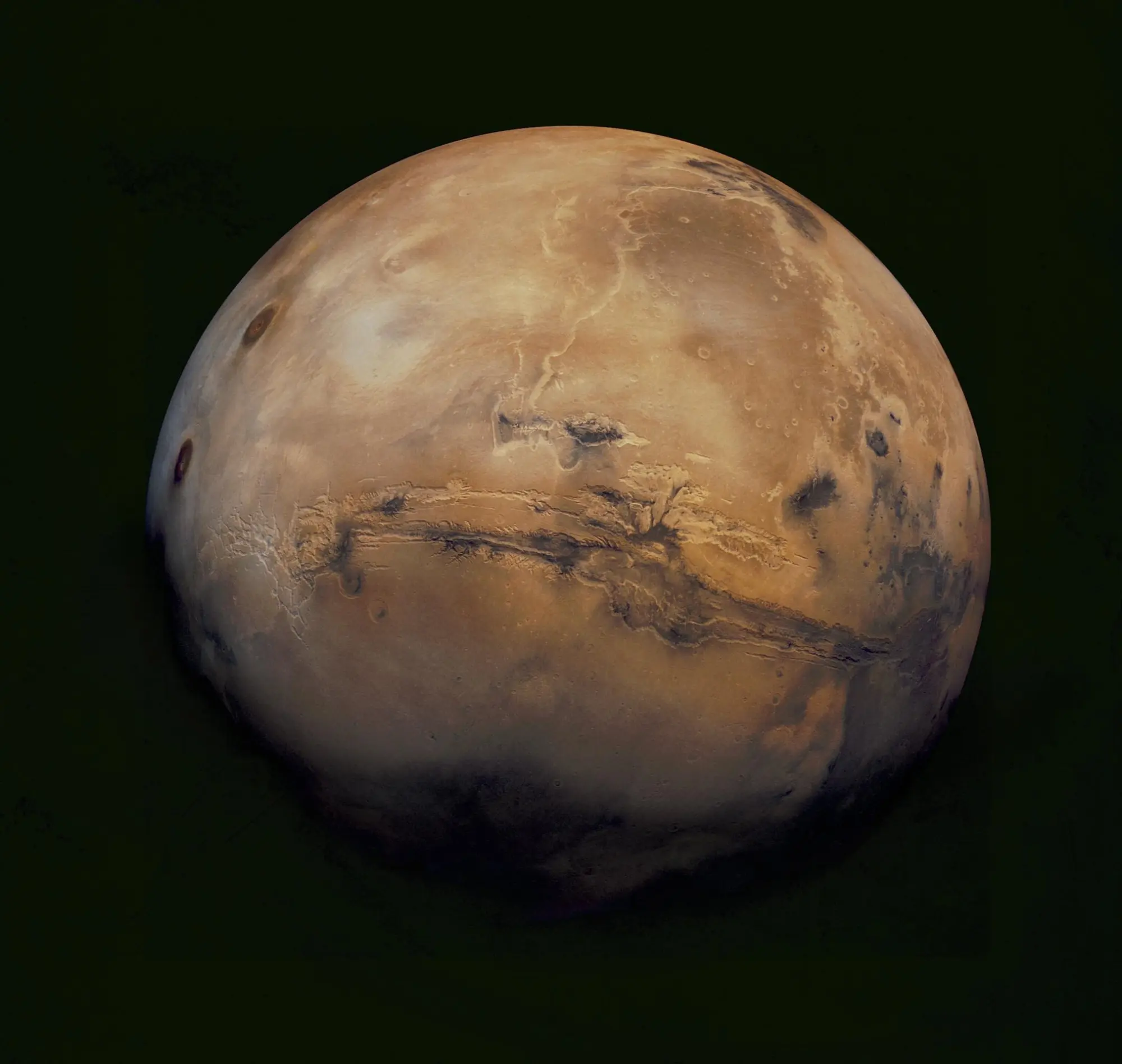
Stand on the plains of Gale Crater and the first thing that would strike you is the silence. No wind sound carries the way it does on Earth, because the air here is too thin to carry much of anything. The sky above you is a pale, dusty pink, not blue, and the sun is smaller and fainter than the one you know. Beneath your boots is rust colored soil, iron rich and ancient, the same soil that has been sitting largely undisturbed for billions of years.
It was not always like this. Mars was once a place with rivers that carved valleys, lakes that filled and dried across millions of years, and quite possibly a shoreline. Somewhere between then and now, an entire planet’s worth of water disappeared, its thick atmosphere thinned to almost nothing, and a world with real potential for life became the frozen desert you are standing in now.
Every grain of that rust colored soil beneath your boots has a story written into it, one carved into Mars’s crust, its volcanoes, its dry riverbeds, and its magnetic field, or rather, the field it used to have. Keep walking.
Mars at a Glance
| Property | Value |
|---|---|
| Distance from the Sun | About 228 million kilometers (142 million miles) |
| Diameter | 6,779 kilometers, roughly half the size of Earth |
| Day length | 24 hours, 37 minutes |
| Year length | 687 Earth days |
| Axial tilt | About 25 degrees, close to Earth’s 23.5 degrees |
| Surface gravity | 38 percent of Earth’s |
| Atmosphere | Thin, over 95 percent carbon dioxide |
| Average temperature | Around minus 63 degrees Celsius |
| Tallest volcano | Olympus Mons, about 22 kilometers high |
| Largest canyon | Valles Marineris, over 4,000 kilometers long |
| Water today | Frozen at the poles, and likely liquid underground |
| Moons | Phobos and Deimos, discovered in 1877 |
| Named after | The Roman god of war |
A World Named for War
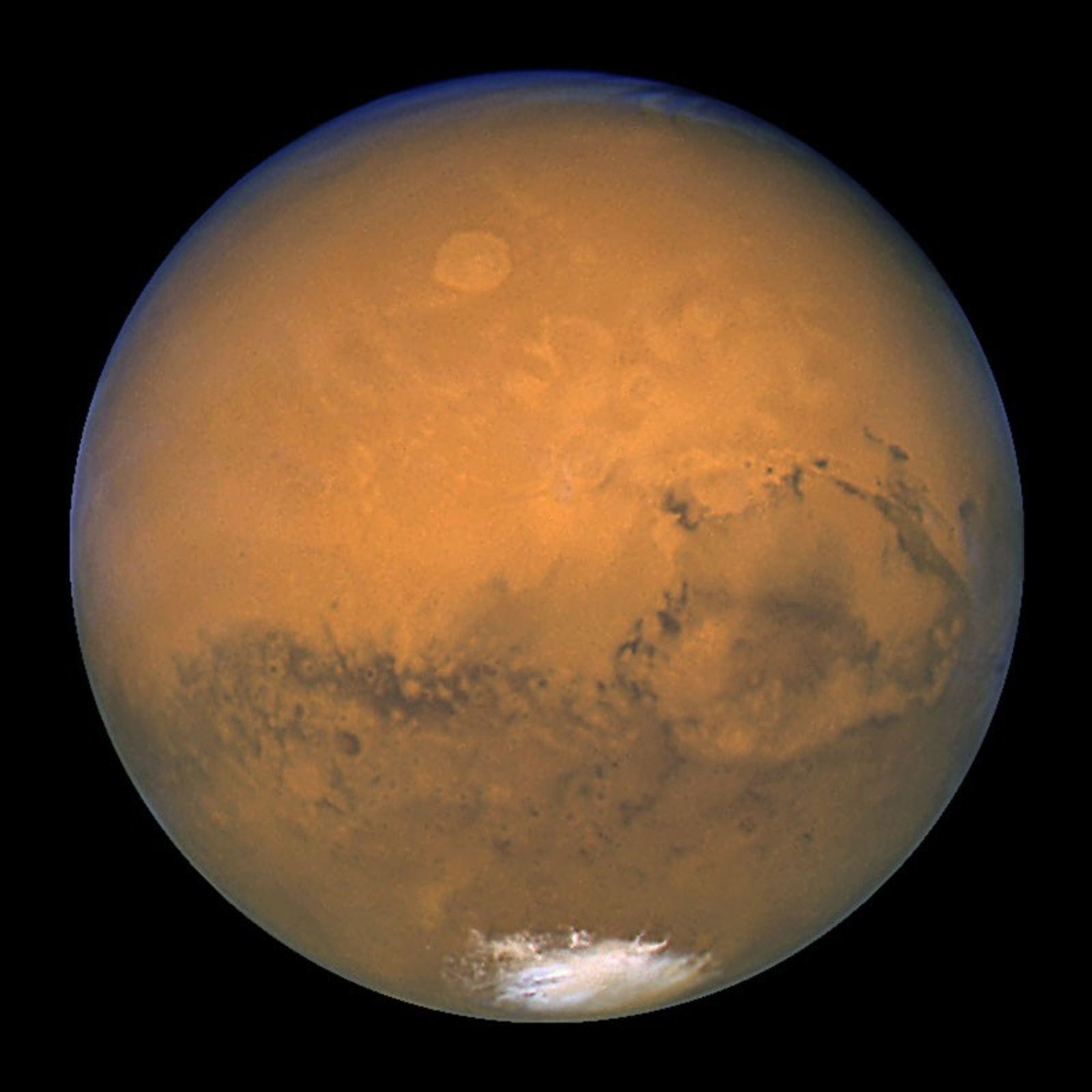
Picture yourself as one of the first stargazers to notice it. Long before telescopes, before Rome, before Egypt built its pyramids, you look up on a clear night and see a point of light burning an unmistakable red among the white ones. You would have wondered what it was too. Mars has been visible to the naked eye for as long as humans have looked up, and its color made an impression on nearly every culture that recorded it.
Ancient Egyptian astronomers called it “Her Desher,” the red one. Babylonian records tracked its motion centuries before telescopes existed. The Romans eventually named it after their god of war, a fitting choice for a point of light with the color of blood and fire, and that name has stuck in most Western languages ever since.
Kneel down on the Martian surface today and pick up a handful of soil, and you would understand instantly why the ancients reached for war and blood to describe it. The red color itself comes down to simple chemistry. The Martian surface is rich in iron, and over billions of years that iron has oxidized, essentially rusting, in a process similar to what happens to an iron nail left out in the rain on Earth.
The result is a fine, reddish dust of iron oxide that coats nearly the entire planet and gets kicked into the atmosphere during storms, which is also why the Martian sky itself often takes on a pale, dusty pink or butterscotch hue rather than the blue you grew up under.
Telescopic observation added its own strange chapter to the story. In the late 1800s, Italian astronomer Giovanni Schiaparelli mapped what he called “canali,” Italian for channels, across the Martian surface. The word was mistranslated into English as canals, implying deliberate construction, and the idea that intelligent Martians had built a planet spanning irrigation system captured the public imagination for decades.
American astronomer Percival Lowell became the idea’s most vocal champion, building an entire observatory partly to study it. Later, higher resolution imaging revealed the canals were an optical illusion, faint surface features and the limits of period telescopes tricking the eye into connecting dots into lines. The real Mars you are about to walk through turned out to be stranger, and in its own way more interesting, than the imagined one.
A World Built Unevenly
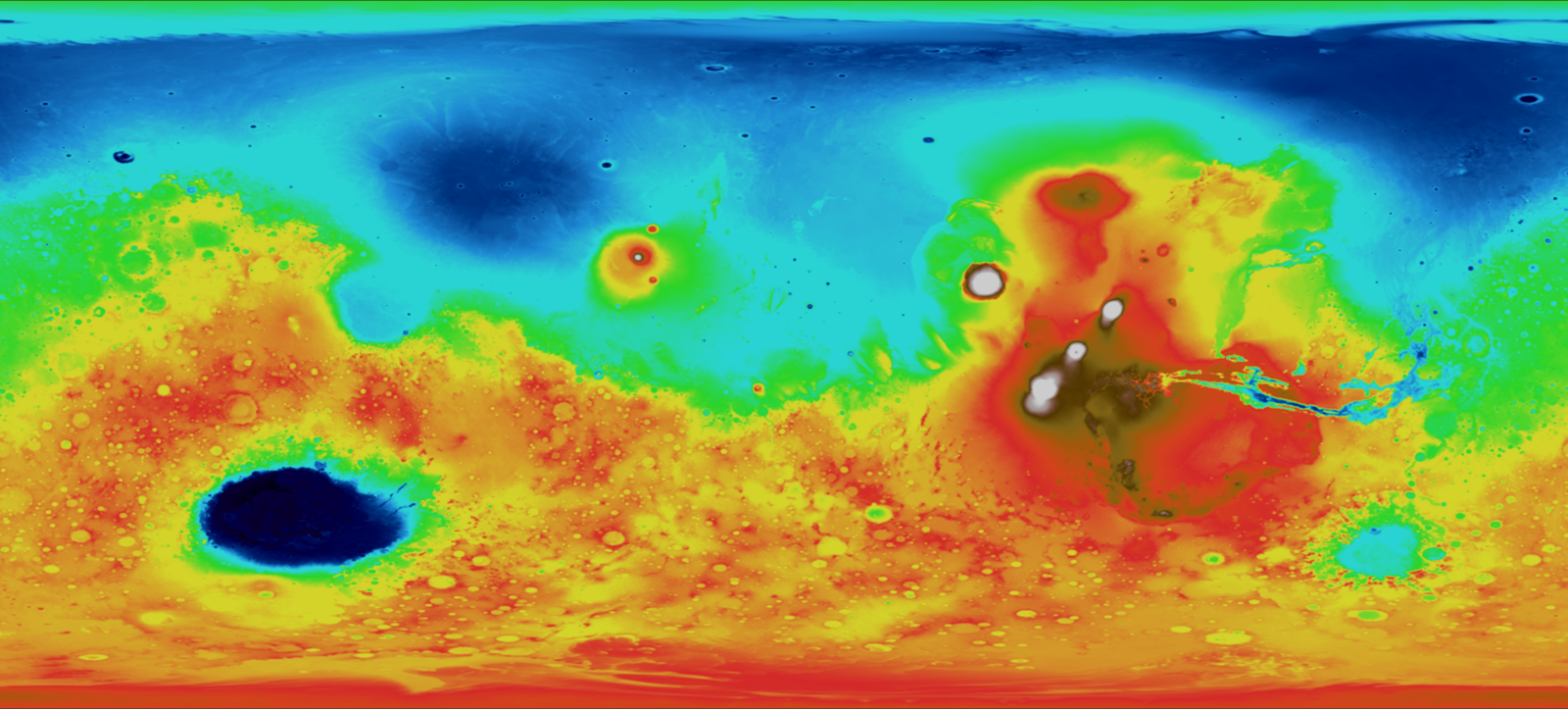
Rise above Mars in your mind, high enough to see the whole curve of it at once, and strip away the atmosphere entirely so you are looking at bare rock. One feature would dominate your view before anything else. The planet is split almost exactly in half by elevation. The southern hemisphere sits several kilometers higher than the north, is scarred with ancient impact craters, and looks every bit as old as it is.
The northern hemisphere is smoother, lower, and younger, as though something resurfaced it long after the south had already finished forming.
Planetary scientists call this the Martian dichotomy, and despite decades of orbital mapping, its cause is still debated. One leading idea is that an enormous impact early in Mars’s history blasted away the northern crust and left the giant basin you would be looking down at. Another possibility is that the dichotomy formed from within, through uneven convection in the planet’s mantle that thickened the crust in the south while leaving the north thin.
Both ideas are consistent with the data scientists have. Neither has been proven outright. That kind of honest uncertainty runs through almost everything known about Mars’s deep past.
What Is Actually Beneath Your Feet
Everything above your head and beneath your boots so far has been surface. To understand why Mars became the world it is, you have to go deeper, down through the crust and into the layers that decide a planet’s entire fate.
Mars has a crust thicker and older on average than Earth’s, a rocky mantle beneath that, and at the very center a core made largely of iron, nickel, and sulfur, believed to be at least partly molten even today based on seismic data recorded by NASA’s InSight lander during its four years listening to the planet’s interior.
That core is smaller relative to the whole planet than Earth’s is, and it cooled faster, for a simple reason you already know instinctively if you have ever noticed how quickly a small cup of coffee goes cold compared to a large pot. Smaller objects lose heat faster than larger ones.
Mars is about half Earth’s diameter, and that difference in scale, multiplied out over four and a half billion years, is the root cause of nearly everything that happened to this planet next. A core that cools too quickly stops churning. A core that stops churning stops generating a magnetic field. And a planet that loses its magnetic field loses far more than a compass heading.
Where the Water Went
Walk across the plains of Mars today and you will not find a single drop of standing water anywhere on the surface. It was not always this way, and the evidence is no longer seriously in dispute. Orbiting spacecraft have mapped branching valley networks that look unmistakably like dried river systems beneath your feet. Deltas sit fanned out where rivers once emptied into standing bodies of water.
NASA’s Curiosity rover has spent more than a decade inside Gale Crater confirming that the ground you would be standing on once held a lake system that filled and evaporated repeatedly over millions of years. Across the planet, Perseverance has documented similar evidence in the delta of Jezero Crater.
The most striking recent evidence goes further than isolated lakes. Researchers studying Mars’s northern plains have identified what may be a fossilized coastal shelf, essentially the geological signature of a shoreline left behind after an ocean dried up.
The idea is reinforced by China’s Zhurong rover, which detected buried, beach like sediment layers in that same northern region. Some estimates now suggest pockets of surface water may have persisted on Mars until as recently as two billion years ago, far later than scientists once assumed. Seismic data from NASA’s InSight lander further suggests enough liquid water may remain trapped underground beneath you right now to fill an entire ocean.
So the water was there. The deeper question, the one that matters more, is where it went and why.
The short answer is that Mars lost the fight against its own size, and the story of that fight deserves its own telling.
The Shield That Failed
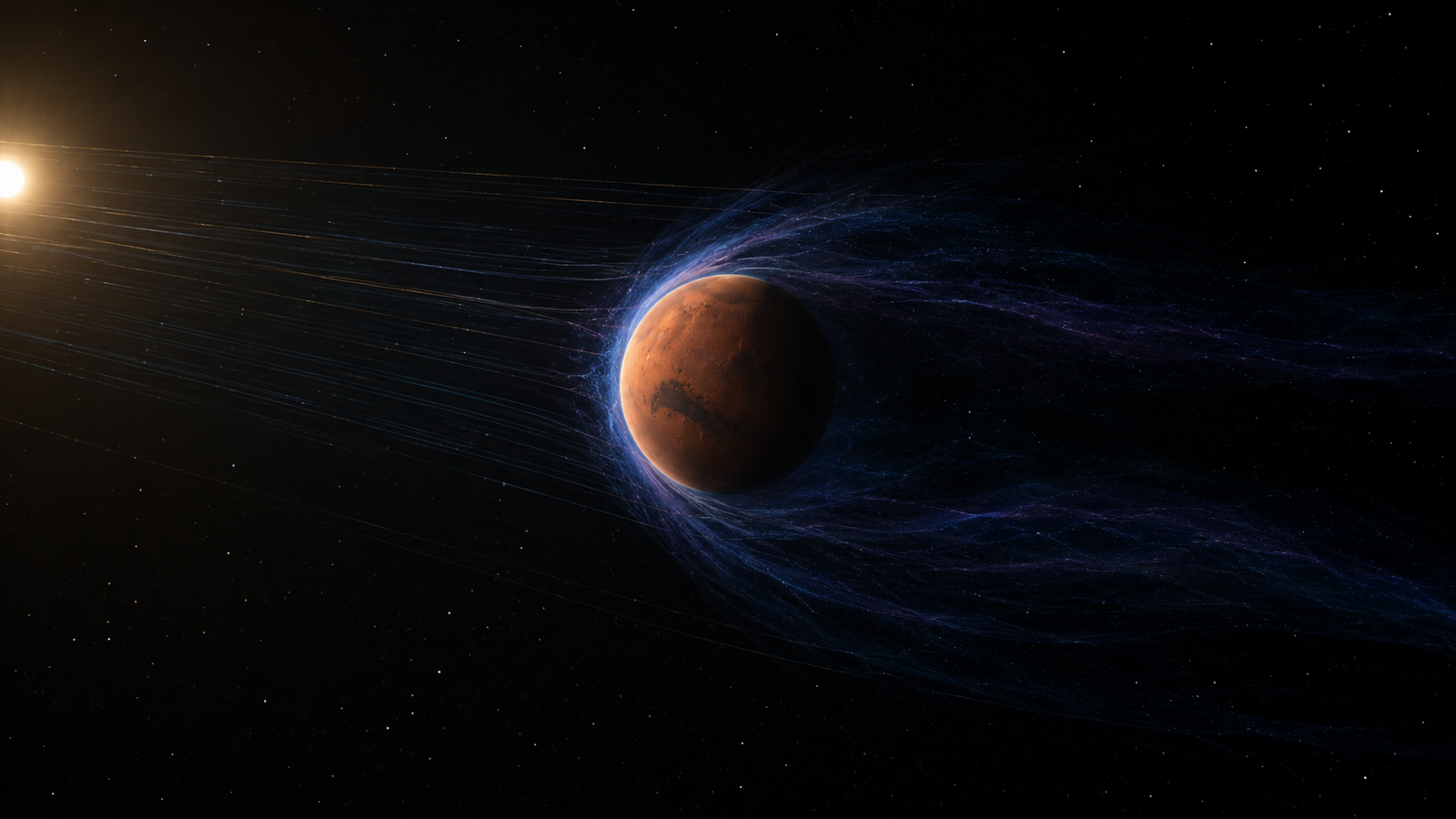
Imagine standing on Mars during a solar storm today, fully exposed, with nothing but your suit between you and the sun’s charged particles streaming past. Earth’s magnetic field would deflect nearly all of that radiation harmlessly around you if you were standing at home instead. Mars offers you no such protection, and understanding why takes you back to that cooling core beneath your boots.
Mars is smaller than Earth, which means it cooled faster on the inside. Its molten iron core eventually stopped churning vigorously enough to sustain a global magnetic field, the kind Earth still generates today through the same restless motion in its own core. Without that shield, the solar wind was free to strip particles from your upper atmosphere, slowly, over billions of years, the way wind erodes a sandcastle grain by grain rather than all at once.
As the atmosphere thinned around you, the surface pressure eventually dropped below the point where liquid water could remain stable on the surface at all. Water that did not escape into space either froze into the polar caps you can still see today or retreated underground beneath you, where a surprising amount may still be hiding.
Seismic data from NASA’s InSight lander suggests Mars could be holding enough liquid water beneath its crust, locked away in porous rock, to fill an entire ocean you will never see.
A Year Nearly Twice as Long, and Seasons Not So Different
Live through a full year on Mars and you would recognize the rhythm immediately, even if the calendar feels wrong. Mars tilts on its axis by roughly 25 degrees, remarkably close to Earth’s own 23.5 degree tilt, which means you would experience four seasons in a pattern you already know rather than the extreme, sideways seasons of a planet like Uranus.
The catch is timing. Because Mars orbits the sun once every 687 Earth days, almost twice as long as an Earth year, each season you live through would last roughly twice as long as the one you grew up with. A Martian winter could stretch for months longer than anything you have ever endured, and because Mars’s orbit is noticeably more elliptical than Earth’s, you would find the southern hemisphere locked into shorter, more intense summers and longer, colder winters than the north.
A single Martian day, called a sol, runs 24 hours and 37 minutes, close enough to the day you know that mission planners have been able to keep rover teams working on something resembling a normal human schedule, just slowly drifting later each day relative to Earth time.
This near match in day length is one of the more oddly comforting facts about standing there. Everything else about the planet would feel alien. The rhythm of sunrise and sunset would feel almost like home.
The Volcano That Should Not Exist
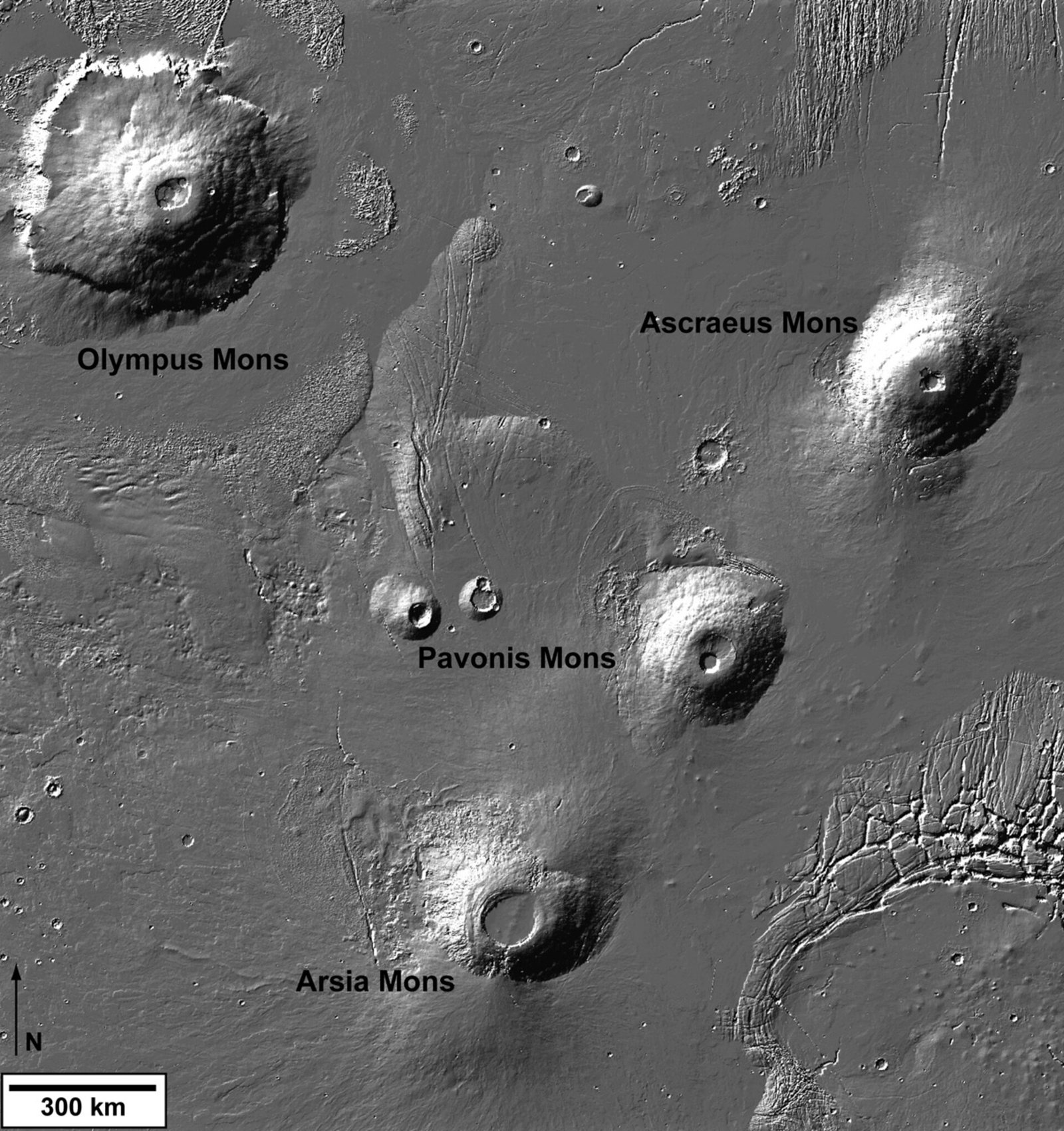
Stand at the base of Olympus Mons and look up, and you will not even be able to see the summit. The slope is so gradual and the mountain so vast that the curve of the horizon hides its own peak from you. Nothing on Mars illustrates the consequences of its geology better than this single volcano. At roughly 22 kilometers high, it is the tallest in the solar system, nearly two and a half times the height of Mount Everest measured from sea level, and wide enough at its base to cover an area close to the size of Arizona.
On Earth, a volcano like this could never form beneath you. Earth’s crust is broken into moving tectonic plates, so even a stationary hot spot in the mantle eventually finds itself erupting beneath a different patch of crust as the plate above it drifts. That is why Hawaii is a chain of islands rather than one impossibly tall mountain.
Mars has no plate tectonics. Its crust is a single, unbroken shell sitting atop the mantle. When a hot spot formed beneath what is now the Tharsis region, roughly four billion years ago, it kept erupting in the same place for hundreds of millions of years, layer after layer of lava building higher with nothing to carry the crust away.
Tharsis itself grew so massive that many planetary scientists believe its weight actually caused the entire planet to shift relative to its own spin axis, a slow rotation of the crust and mantle known as true polar wander. A single volcanic province, in other words, may have been heavy enough to tilt a planet.
A Canyon That Would Swallow a Continent
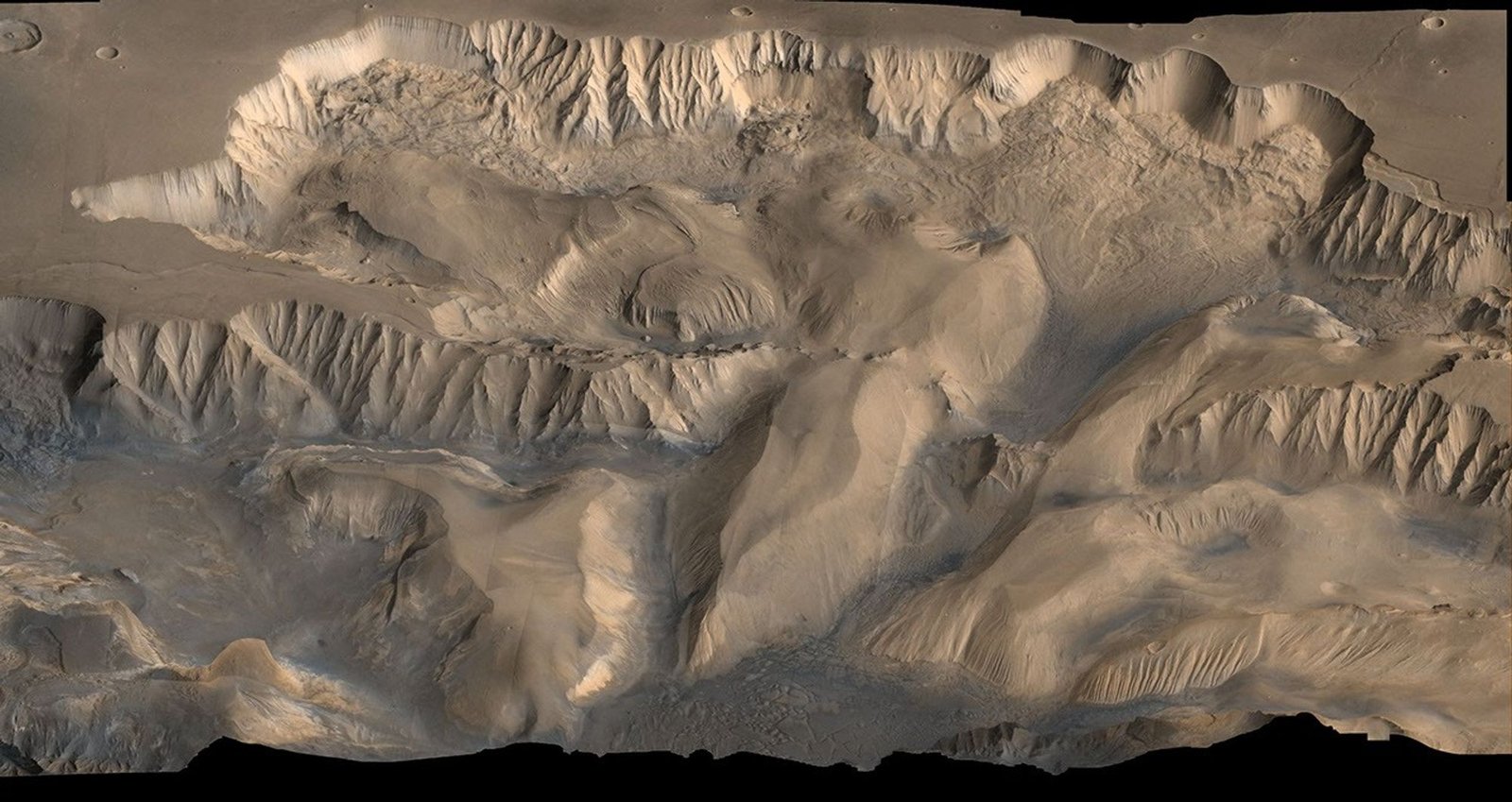
Stand at the rim of Valles Marineris and you will not be able to see the far wall. If Olympus Mons is Mars’s answer to a mountain, this canyon is its answer to a wound, and it is large enough to make the ground beneath you feel small.
Stretching more than 4,000 kilometers east from the flank of the Tharsis bulge, the canyon system runs nearly a quarter of the way around the planet, and it plunges as much as 7 to 10 kilometers below the surrounding plains in its central troughs, depending on which section of the canyon and which topographic reference point is used to measure it. Its width is not a single number, and that is worth understanding rather than flattening away.
Individual chasms within the system typically run 100 to 200 kilometers across, which is where most modern figures come from, but where several of those chasms merge in the canyon’s central region, NASA’s own Viking orbiter imagery shows the combined system spanning as much as 600 kilometers rim to rim. Both figures are real, describing different parts of the same wound in the crust.
Laid across the continental United States, the full length would stretch from the West Coast to the East Coast with room to spare. Earth’s Grand Canyon, by comparison, is roughly 450 kilometers long and a little over a kilometer and a half deep at its deepest, a respectable gash by Earth standards and a rounding error next to the one you would be standing over.
The Grand Canyon was carved patiently by the Colorado River over millions of years. Valles Marineris formed almost the opposite way, through violence rather than patience.
As the Tharsis volcanic bulge swelled upward over hundreds of millions of years, it stretched and cracked the crust along its eastern edge, opening deep parallel faults called grabens. Later, sections of crust between those faults collapsed downward, and catastrophic floods, landslides, and possibly the seepage of groundwater widened and deepened the system further.
Some sections of the canyon floor show layered deposits that may be the remains of ancient lakes that once pooled inside the chasm itself, trapped between towering walls of rock.
Even the individual pieces of Valles Marineris humble Earth on their own. Tithonium Chasma, one sub canyon at the system’s western end, alone runs roughly 810 kilometers long and over 6 kilometers deep, a single chasm within the larger wound that is already longer than the entire Grand Canyon and more than three times as deep.
Reading the Rocks for Signs of Life
Kneel down and pick up a rock from the floor of Gale Crater, and you would be holding one of the best clues Mars has ever offered about whether it was ever truly alive. Mars’s geology and the search for life have become almost impossible to separate, because the rocks themselves are the most reliable record of whether the planet was ever truly habitable. Wet is only half the question; whether the chemistry there was ever capable of supporting biology is the harder half.
Inside Gale Crater, Curiosity’s onboard chemistry lab has detected the largest organic molecules ever found on Mars, long carbon chains recovered from an ancient mudstone that scientists have nicknamed Cumberland, the very ground beneath your boots. These molecules resemble fragments of fatty acids, the class of compounds that on Earth form the membranes of every living cell.
Organic molecules on their own are not proof of biology. They can form through ordinary geological chemistry with no living process involved at all. What makes the Cumberland find compelling is its context. The surrounding mudstone shows clear evidence of repeated groundwater circulation long after burial, recorded in mineral veins and chemical patterns that mean the rock stayed chemically active for a long stretch of time, giving any potential chemistry room to develop.
Travel to the opposite side of the planet and Perseverance has turned up its own puzzles inside Jezero Crater. In 2024 the rover identified unusual leopard spot patterns in a rock nicknamed Cheyava Falls, mineral textures that on Earth can sometimes form through microbial activity, though purely chemical explanations remain entirely possible.
More recently the rover has found bright white clay minerals that typically require sustained contact with water to form.
A separate discovery, unrelated to either rover, adds its own twist to the sulfate story. Studying orbital data from the Mars Reconnaissance Orbiter’s CRISM instrument near Valles Marineris, well away from either rover’s location, SETI Institute scientist Janice Bishop and colleagues identified an unusual iron sulfate that laboratory experiments suggest may be an entirely new mineral, never before catalogued on Earth or Mars.
The team’s lab work indicates it likely formed when older sulfate layers deposited by ancient water were later heated by volcanic or geothermal activity in the presence of oxygen, a reminder that some of Mars’s most interesting chemistry is still being uncovered from orbit rather than on the ground.
None of this amounts to a discovery of life. Taken together, though, it paints a picture of a planet that spent a genuinely long window of its early history with the right ingredients sitting on the table.
Ice Caps Made of Two Different Things
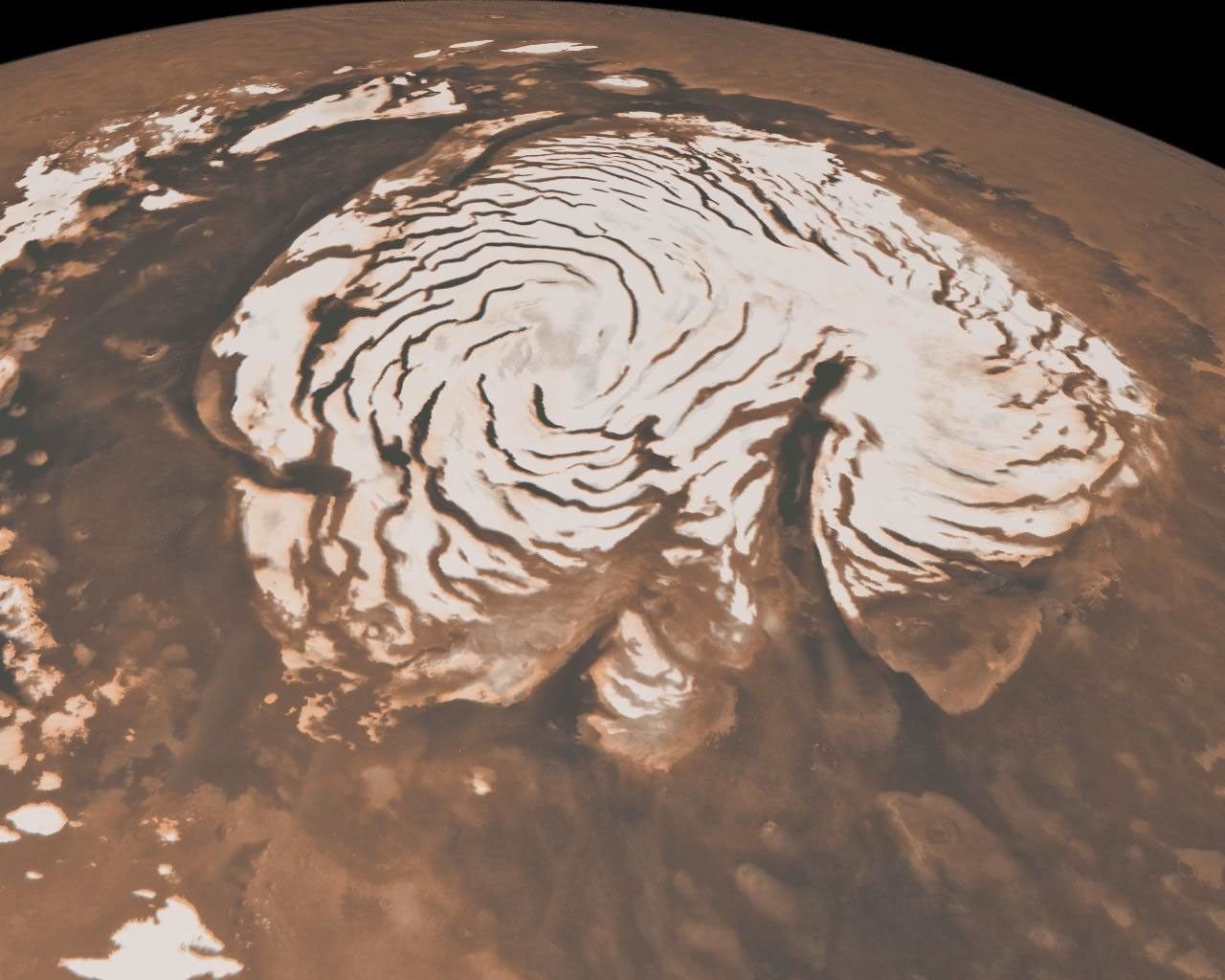
Travel to either pole and you would find yourself standing on ice that genuinely breathes with the seasons, growing and shrinking as the planet cycles between summer and winter, visible even through amateur telescopes back on Earth. What makes the caps beneath your boots scientifically interesting is that they are not made of one substance.
Each cap has a permanent core of water ice that persists year round, buried beneath a seasonal layer of frozen carbon dioxide, essentially dry ice, that forms each winter as the thin atmosphere itself partially freezes onto the surface and then sublimates directly back into gas each spring.
Walk south instead of north and the polar cap beneath you holds a more dramatic secret. Radar data gathered by ESA’s Mars Express orbiter has pointed to what appears to be liquid water hidden beneath layers of ice near the south pole, kept in a liquid state by a combination of pressure and dissolved salts that lower its freezing point.
The interpretation remains actively debated among planetary scientists, with some researchers proposing that the radar signal could instead be explained by unusual clay or mineral layers rather than liquid water. Either way, the ground beneath you at either pole is not simply frozen and finished. It is still one of the more actively studied regions on the entire planet.
Two Small, Doomed Moons
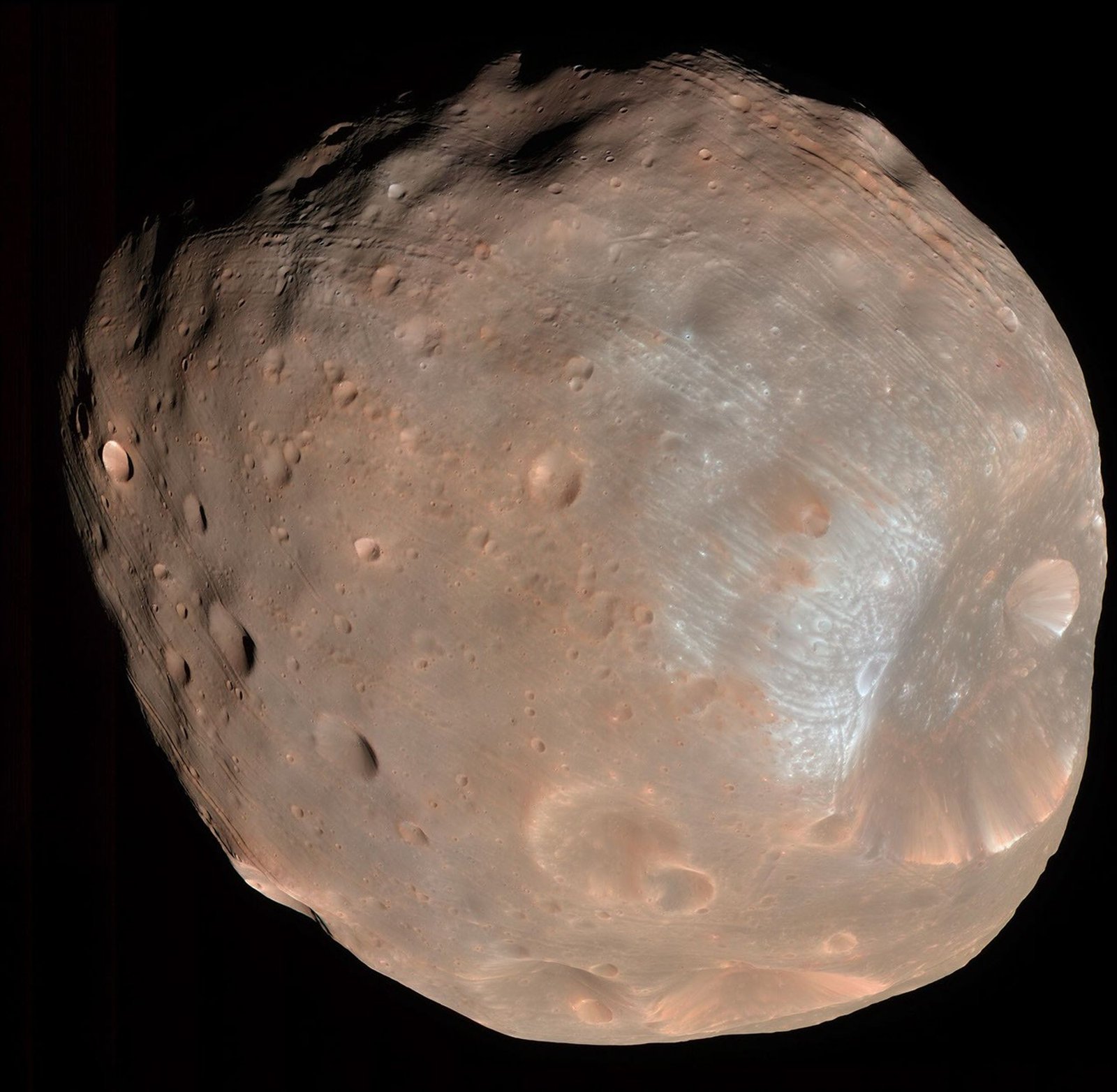
Look up into the Martian night sky and you would see two moons instead of one, and neither would look anything like the moon you grew up watching. Mars is orbited by two moons, Phobos and Deimos, discovered within days of each other in August 1877 by American astronomer Asaph Hall.
Both are small, lumpy, heavily cratered objects, closer in size and shape to asteroids than to a proper planetary satellite, with Phobos measuring only about 22 kilometers across and Deimos roughly half that.
Their origin is still an open question. For decades the leading idea was that both moons are captured asteroids, snagged from the nearby asteroid belt by Mars’s gravity, an idea supported by their dark, carbon rich composition. The problem is their orbits.
Captured objects tend to settle into tilted, stretched out paths around a planet, while Phobos and Deimos both orbit in tidy, nearly circular paths aligned almost exactly with the Martian equator, an arrangement that is difficult to explain through simple capture.
An alternative theory holds that a massive ancient impact blasted debris into orbit around Mars, similar to how Earth’s own moon is thought to have formed, with that debris later clumping together into the two small moons you would see overhead.
Look up often enough over the next fifty million years and you would eventually see Phobos disappear.
It orbits so close to Mars, only about 9,400 kilometers above the surface, that gravitational tidal forces are dragging it steadily inward, roughly 1.8 meters closer every century. Scientists expect Phobos will either crash into the Martian surface or be torn apart by gravity into a ring of debris circling the planet, not unlike the rings of Saturn on a much smaller scale.
Pieces of Mars Already on Earth
You do not need to travel to Mars to hold a piece of it. Remarkably, scientists did not need to wait for a sample return mission to get their hands on actual fragments of the planet. Powerful asteroid impacts on the Martian surface have, on rare occasions, blasted rock fast enough to escape the planet’s gravity entirely, sending it drifting through the solar system for millions of years until a small number of pieces eventually collided with Earth.
Fewer than 400 confirmed Martian meteorites have ever been found, identified by trapped gas bubbles inside them that precisely match the unique atmospheric composition measured on Mars by NASA’s Viking landers in 1976.
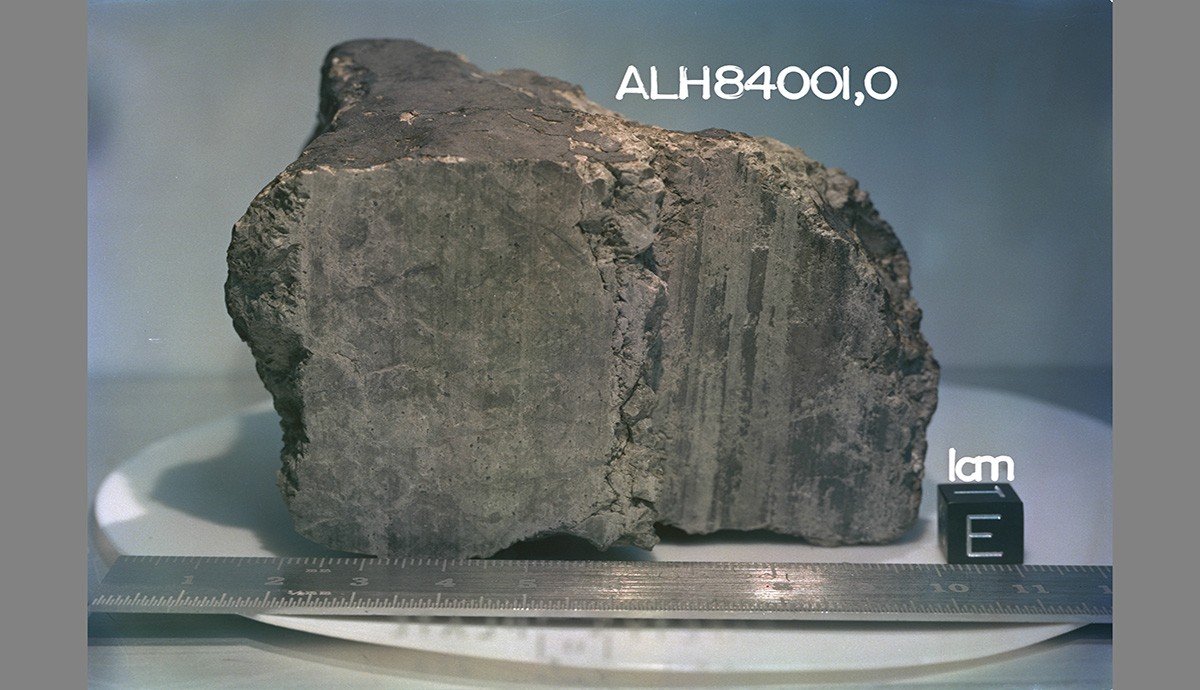
The most famous of these is ALH84001, a chunk of Martian volcanic rock discovered in Antarctica in 1984 and later dated to over four billion years old, making it older than any rock ever found on Earth. In 1996, NASA scientists announced that the meteorite contained microscopic structures that resembled fossilized bacteria, along with carbonate minerals that typically form in the presence of liquid water. The claim ignited a public sensation and a fierce scientific debate.
Most researchers ultimately concluded the structures could be explained by non biological processes, but the meteorite permanently changed how seriously the search for Martian life was taken, and it remains one of the most intensively studied rocks in the world.
A Planet That Is Not Entirely Finished
Stand on Mars long enough and you might start to believe it is a geologically dead world, a place where the story ended billions of years ago and nothing has happened since. That is not quite accurate. Beneath your feet, seismometers aboard NASA’s InSight lander recorded marsquakes throughout its mission, proof that heat is still moving through the planet’s interior even now.
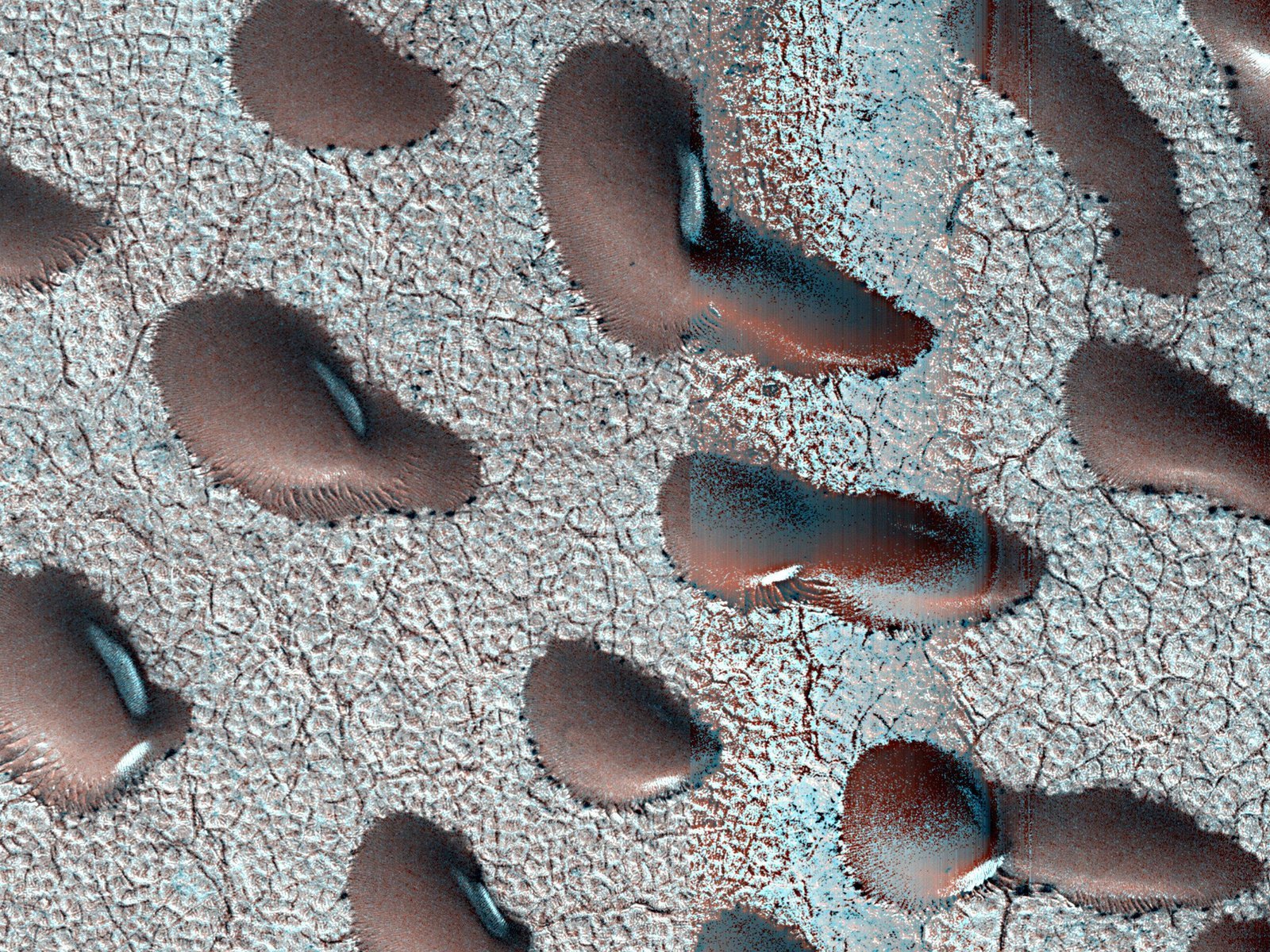
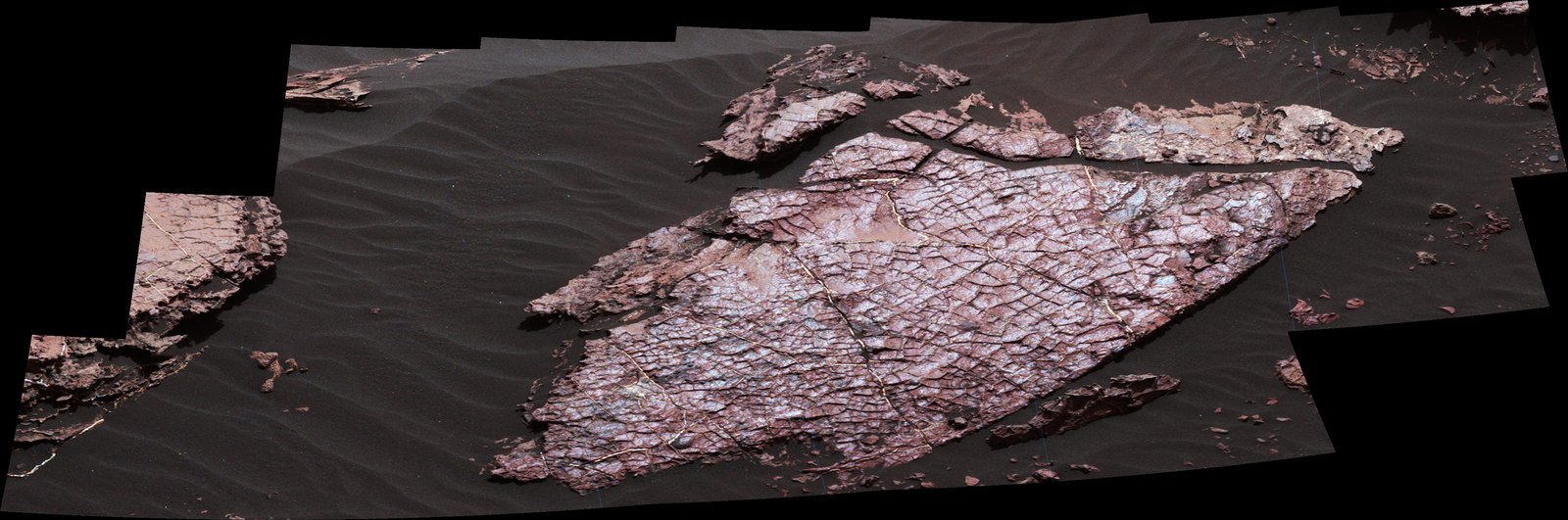
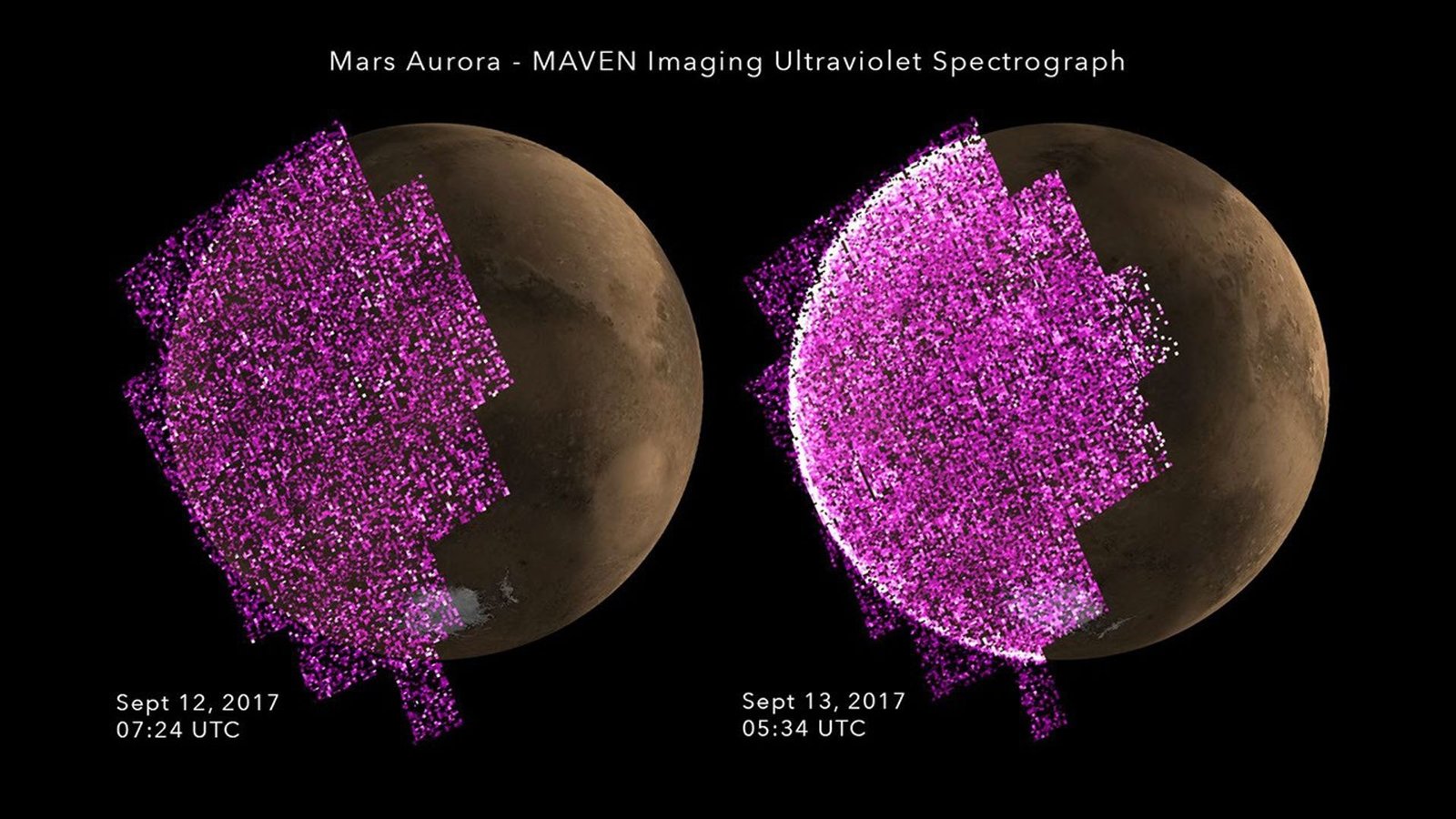
Around you, recent images from Curiosity have captured striking networks of polygon shaped cracks in the ground, patterns that form as sediment dries and contracts over time. Above you, NASA’s MAVEN mission has discovered that Martian auroras form through a process surprisingly similar to Earth’s own, driven not by a global magnetic field but by the patchwork of leftover magnetic regions still embedded in the ancient crust.
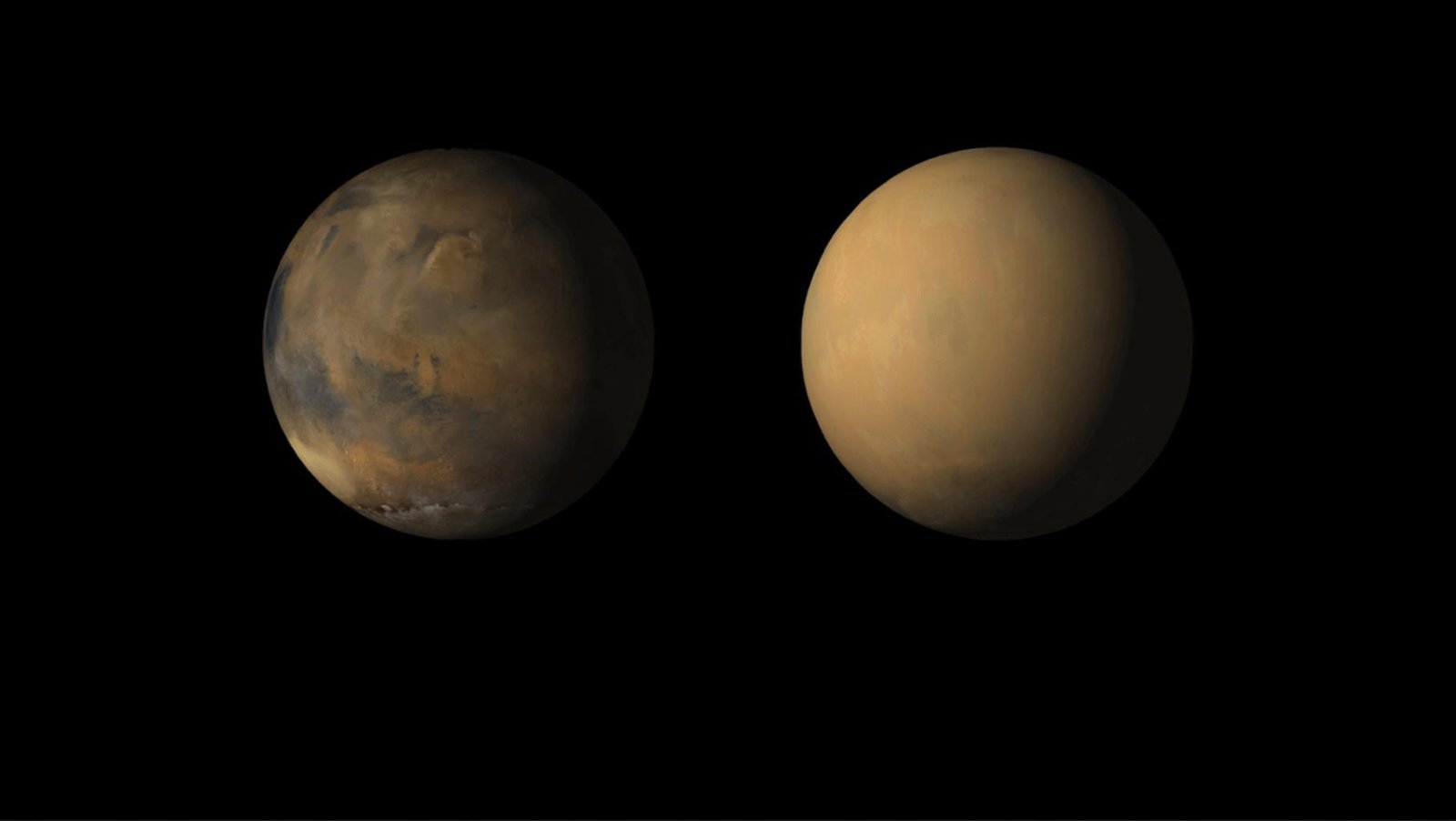
Dust storms remain the most visible sign that the thin air around you is still very much in motion. Some grow large enough to engulf the entire planet, lasting for weeks and occasionally shutting down solar powered missions entirely. The Mars you see in a still photograph is not a frozen snapshot of a dead world. It is one frame in a process that is still, slowly and quietly, ongoing around you.
Future missions are aimed squarely at the biggest question still hanging over the ground beneath you. The European Space Agency’s Rosalind Franklin rover, expected to launch in late 2028 and land in 2030, is designed specifically to drill deeper into the subsurface than any previous mission, searching the northern plains for the kind of preserved organic material that near surface radiation on Mars tends to destroy.
If an ancient ocean really did leave a shoreline behind up there, Rosalind Franklin may be the mission that finds it.
What Mars Actually Sounds Like
Stand still on Mars and listen, and you would notice the silence before anything else. For most of the space age, nobody knew what that silence actually sounded like, because no microphone had ever survived the trip. That changed in February 2021, when NASA’s Perseverance rover touched down carrying two working microphones and returned the first true audio ever recorded on the surface of another planet.
What scientists heard back was stranger than most predictions. Sound on Mars travels only about 240 meters per second toward your ears, roughly 30 percent slower than on Earth, because the atmosphere is so thin and so overwhelmingly carbon dioxide. Higher pitched sounds, above roughly 240 hertz, actually move slightly faster than lower ones, meaning a sound with both high and low components, like a hand clap next to you, would arrive with a subtle split, the high notes reaching you fractionally before the bass.
Sound also fades far more quickly than on Earth, so most of the ground around you would sit in what researchers describe as a deep, near constant silence, broken occasionally by wind, the crack of a rock zapping laser, or the distant whir of a helicopter’s rotors.
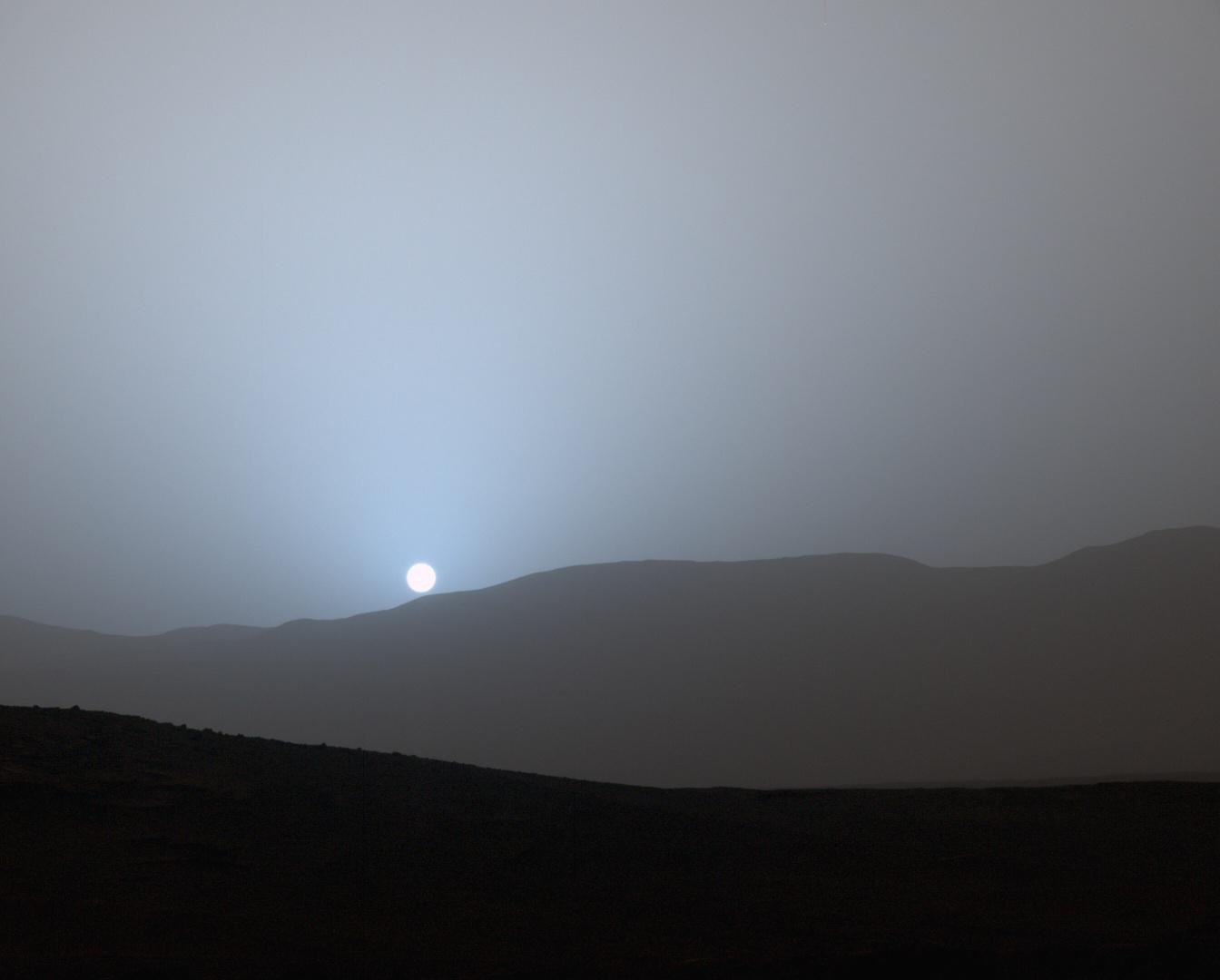
The sky holds its own reversal. On Earth, sunsets turn warm and red because our thick, oxygen rich atmosphere scatters blue light away in every direction while sunlight is low on the horizon, leaving the reds and oranges behind.
Mars runs the process backward. Its fine, suspended reddish dust scatters red light away from the line of sight during sunset while allowing blue light to pass through more directly toward an observer, so images captured by NASA’s rovers consistently show a pale blue glow surrounding the setting sun, with the rest of the daytime sky remaining the familiar dusty pink.
It is one of the most quietly strange facts about Mars, and one of the least talked about, that a planet famous for its red daytime sky produces blue sunsets.
The Radiation Problem Nobody Can See
Stand outside on Mars for even a single day and you would be absorbing something you cannot see, hear, or feel, but that your body would carry with it regardless. Mars has no meaningful ozone layer and no global magnetic field, and its atmosphere is less than one percent as thick as Earth’s, which means the planet offers you almost none of the natural shielding that protects life on Earth from space radiation.
NASA’s Curiosity rover has directly measured this environment using its onboard Radiation Assessment Detector, recording an average dose rate on the surface of roughly 0.64 to 0.67 millisieverts per day from galactic cosmic rays alone. That may sound small, but it adds up fast. A 500 day stay on the Martian surface alone would total around 335 millisieverts absorbed into your body, more than 100 times the roughly 3 millisieverts an average person absorbs from natural background radiation on Earth in a full year.
The six to nine month journey to get there is worse, not better, since it happens almost entirely unshielded in interplanetary space, at a measured rate of roughly 1.8 millisieverts per day, higher than the dose rate on the surface itself. A full round trip mission, cruise plus surface stay plus return, adds up to a cumulative dose of roughly 1 sievert, a figure NASA has cited as approaching the career radiation exposure limit currently set for its astronauts.
This is one of the most consequential differences between Mars and Earth, and one that most general audience articles about the planet barely mention. It is not a hypothetical concern reserved for science fiction.
It is a measured, ongoing environmental hazard that mission planners are actively designing around today, using strategies like thick regolith shielding over future surface habitats, timing missions around the eleven year solar cycle, and studying whether lava tubes beneath the Martian surface, some large enough to hold entire buildings, could serve as naturally shielded shelters for future crews.
Six Decades of Machines on Another World
Every canyon, every crater, every silent gust of wind around you comes from an unbroken run of robotic exploration stretching back more than sixty years, machines that stood where you are standing now.
NASA’s Mariner 4 delivered the first close up images of Mars in 1965, revealing a cratered, moon like surface that briefly deflated hopes of a lush neighboring world. Viking 1 and Viking 2 became the first spacecraft to land successfully and operate on the Martian surface in 1976, directly measuring the atmosphere’s composition in the process.
Pathfinder and its small rover, Sojourner, arrived in 1997, followed by the twin rovers Spirit and Opportunity in 2004, with Opportunity astonishingly continuing to operate for almost fifteen years against an original ninety day mission plan.
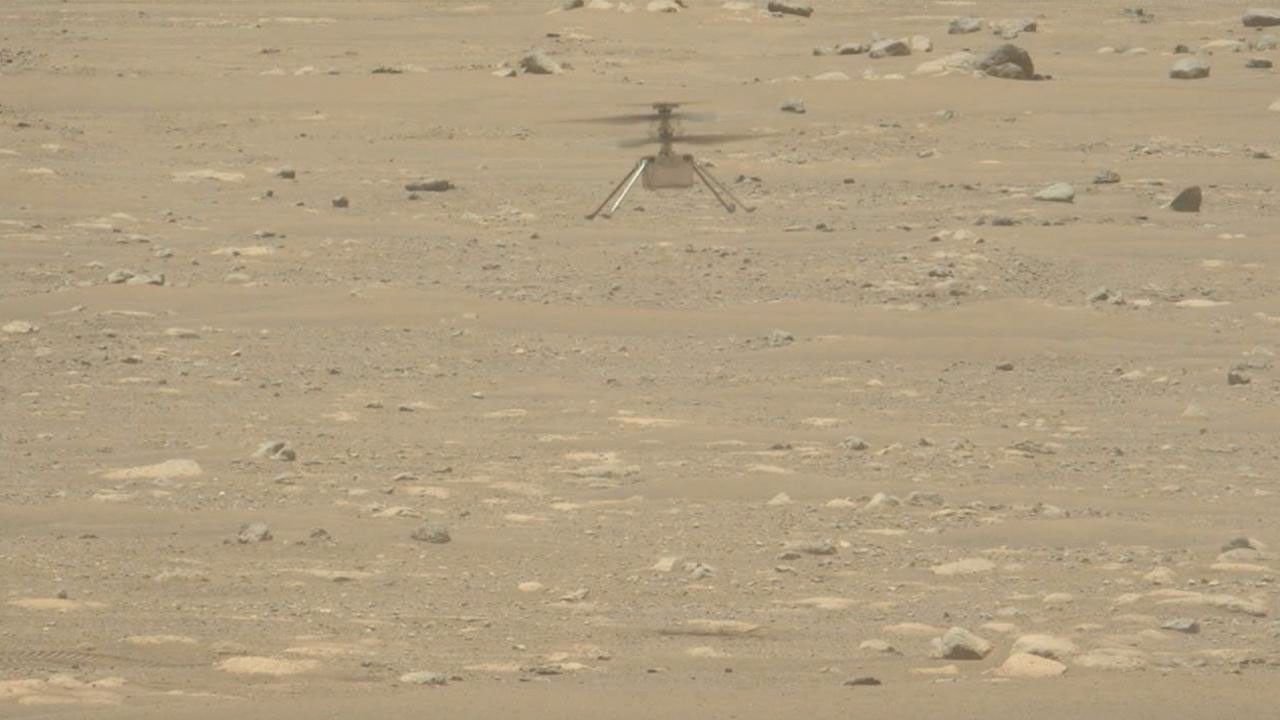
The modern era began with Curiosity’s landing inside Gale Crater in 2012, followed by Perseverance and its helicopter companion Ingenuity in 2021, the first powered flight ever achieved on another planet.
Today an international fleet studies Mars simultaneously, including orbiters from NASA, the European Space Agency, China, and the United Arab Emirates, alongside the two active rovers on the very surface beneath your boots. The European Space Agency’s Rosalind Franklin rover, expected to launch in late 2028 and land in 2030, is designed to drill deeper beneath the surface than any previous mission, specifically targeting the kind of preserved organic material that radiation tends to destroy near the surface.
NASA and ESA also continue to plan a Mars Sample Return campaign, intended to bring Perseverance’s collected rock cores back to laboratories on Earth for the kind of detailed analysis no rover instrument can match.
Why Mars Still Matters
Mars endures as a subject of fascination not because it is exotic, but because it is legible. Its geology tells a coherent story, written into layers of ancient sediment, fields of frozen lava, and minerals that could only have formed in water. Every rover drill core and every orbital radar sweep adds another sentence to that story, a record of how a rocky planet with real potential for life slowly lost its atmosphere and its oceans over the course of billions of years.
Whether Mars ever crossed the line from habitable to inhabited remains unknown. As a record of what can happen to a rocky world when it loses its magnetic shield and its water, though, Mars is not just a fascinating place to study. It is a mirror worth watching closely.
The Strangest Facts to Take With You
If you remember nothing else from standing on Mars in your imagination, carry these away with you.
- Its sunsets glow blue, the exact reverse of every sunset you have ever watched on Earth
- The tallest volcano in the solar system rises so gradually that you could stand at its base and never see the summit
- A real microphone has recorded real sound there, and it fades to silence faster than sound does at home
- One of its two moons is slowly spiraling toward its own destruction, on a schedule measured in tens of millions of years
- Enough water may be locked beneath its crust right now to fill an entire ocean you will never see
- Pieces of Mars are already sitting in meteorite collections on Earth, waiting for anyone to hold them
FAQ SECTION
Why did Mars lose its atmosphere? Mars is smaller than Earth, so its interior cooled faster and its molten core stopped generating a global magnetic field. Without that magnetic shield, the solar wind was able to gradually strip particles from the upper atmosphere over billions of years, thinning it to less than one percent of Earth’s atmospheric pressure today.
Did Mars really have an ocean? The evidence is strong but not fully confirmed. Scientists have identified what may be a fossilized coastal shelf in Mars’s northern plains, supported by buried beach like sediment layers detected by China’s Zhurong rover. Some estimates suggest surface water may have persisted in some form until roughly two billion years ago.
Why is Olympus Mons so much taller than any volcano on Earth? Earth’s tectonic plates constantly shift, so volcanic hot spots eventually erupt beneath new locations rather than building endlessly in one place. Mars has no plate tectonics, so the hot spot beneath Olympus Mons kept erupting in the same location for hundreds of millions of years, allowing lava to stack far higher than any Earth volcano could ever grow.
Is there still water on Mars today? Yes. Water ice is visible at both polar caps, and evidence from seismic data collected by NASA’s InSight lander suggests a significant amount of liquid water may still exist underground, trapped within porous rock in the Martian crust.
Has life ever been found on Mars? No confirmed evidence of life has been found. Rovers have detected organic molecules and mineral patterns that are consistent with what a habitable environment might leave behind, including large carbon chain molecules found by Curiosity and unusual mineral textures found by Perseverance. None of these findings are proof of biology, and researchers are careful to note that non biological chemical explanations remain possible for all of them.
Is Mars geologically active today? Mars is far less active than Earth, but it is not dead. Marsquakes recorded by the InSight lander show heat is still moving through the planet’s interior, and dust storms, sometimes large enough to cover the entire planet, remain an active and ongoing atmospheric process.
Why is Mars red? Mars is covered in iron rich dust that has oxidized over billions of years, essentially rusting the same way an iron nail rusts in water on Earth. That reddish iron oxide dust coats the surface and gets lifted into the atmosphere, which is also why the Martian sky often looks pale pink rather than blue.
How many moons does Mars have? Mars has two small moons, Phobos and Deimos, discovered in 1877. Both are irregularly shaped and heavily cratered, resembling captured asteroids more than a traditional round moon, and Phobos is slowly spiraling closer to Mars, likely to break apart within about 50 million years.
How big is Valles Marineris compared to the Grand Canyon? Valles Marineris stretches over 4,000 kilometers long and up to 10 kilometers deep in places, making it roughly ten times longer and five to seven times deeper than Earth’s Grand Canyon, which runs about 450 kilometers long and just over 1.6 kilometers deep at its deepest point.
Have pieces of Mars ever been found on Earth? Yes. Fewer than 400 confirmed Martian meteorites have been recovered on Earth, ejected into space by ancient asteroid impacts on Mars and later captured by Earth’s gravity. Scientists confirm their origin by matching trapped gas inside the rocks to the exact atmospheric composition measured on Mars.
How long does it take to get to Mars? Using current propulsion technology, a one way trip to Mars takes roughly six to nine months, depending on the alignment of Earth and Mars in their orbits at the time of launch, which only creates an efficient launch window approximately once every 26 months.
Could humans breathe the air on Mars? No. The Martian atmosphere is over 95 percent carbon dioxide and only about 1 percent as thick as Earth’s atmosphere, meaning it contains neither enough oxygen nor enough pressure to support human breathing without a pressurized suit or habitat.
Why are sunsets blue on Mars? Mars reverses Earth’s sunset colors because of its fine reddish dust. On Earth, a thick atmosphere scatters blue light away during sunset, leaving red and orange behind. On Mars, suspended dust scatters red light away instead, allowing blue light to reach the observer directly around the setting sun, while the rest of the daytime sky stays a dusty pink.
Has anyone actually recorded sound on Mars? Yes. NASA’s Perseverance rover carries two working microphones and recorded the first true audio from the Martian surface in February 2021. The recordings show that sound travels slower on Mars than on Earth and fades out much faster, leaving most of the planet in near constant silence.
How dangerous is radiation on Mars for future astronauts? Very significant. Mars lacks a global magnetic field and has an extremely thin atmosphere, so its surface receives measured radiation doses around 0.64 to 0.67 millisieverts per day from cosmic rays alone, according to NASA’s Curiosity rover. A roughly 500 day surface stay alone would total about 335 millisieverts, more than 100 times a typical year of natural background radiation on Earth, and a full round trip mission adds up to a cumulative dose of roughly 1 sievert, which is why future missions are studying shielded habitats and natural shelters like lava tubes.
Continue the Journey
Mars is one stop on a much longer road through the solar system. If the story of a planet losing its atmosphere and its oceans caught you, the rest of the From Worlds Beyond planet series carries that same cinematic, carefully verified treatment to every other world, from Mercury’s scorched history to the ice giants at the edge of the sun’s reach. Explore the full series and keep going.