
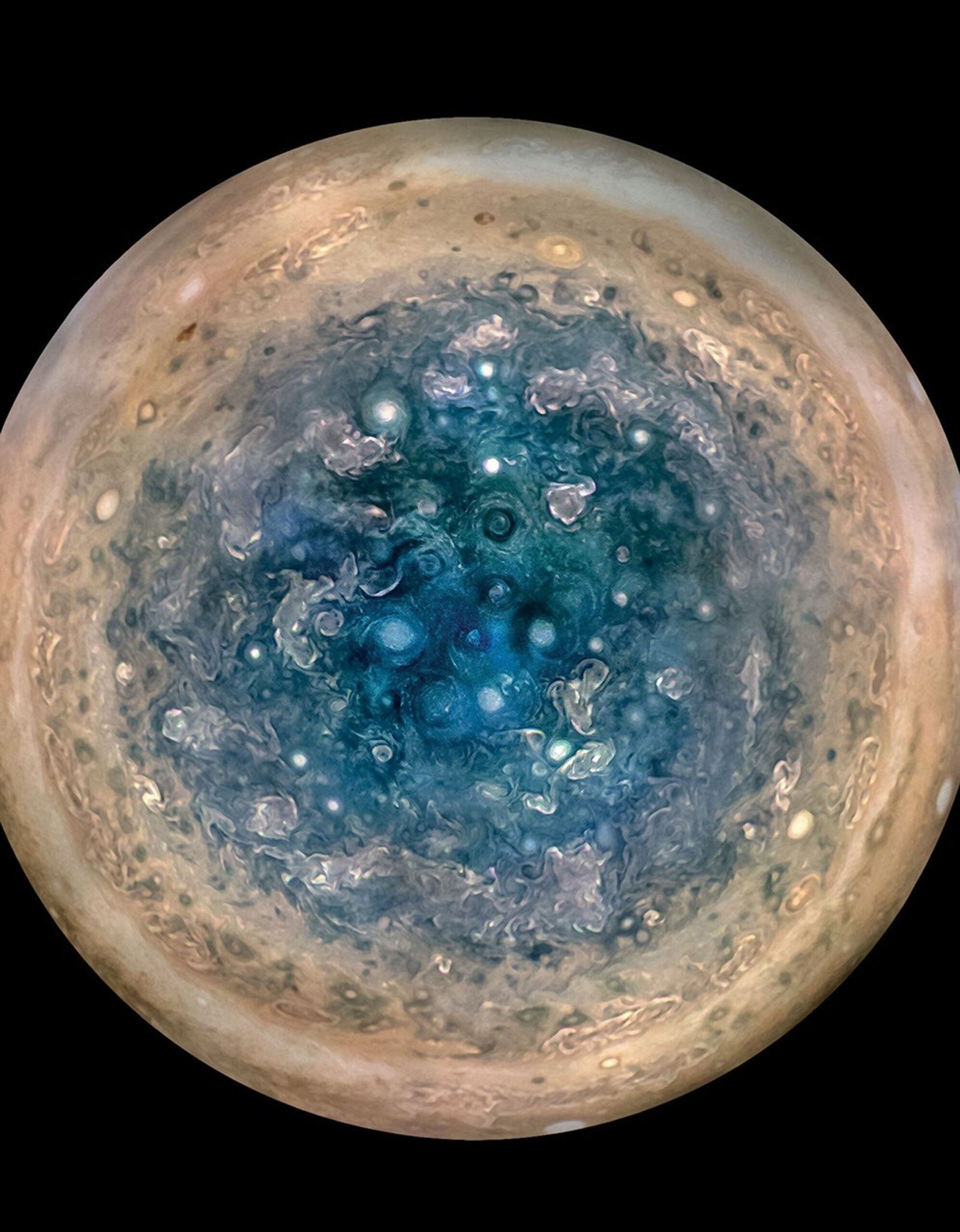
Look up at Jupiter through even a modest telescope and the first thing you would notice is that it does not look like a planet the way Earth does. There is no coastline, no continent, nothing solid for your eye to land on. What you are looking at is the top of an ocean of hydrogen so vast that Earth could be dropped into it and lost.
Jupiter is not a bigger version of the world you live on. It is a fundamentally different kind of object, one that never finished the journey toward becoming a star and instead became something science is still struggling to fully describe.
Beneath those famous orange and cream colored bands sits a planet with the strongest magnetic field of any world in the solar system, a storm larger than Earth that has been raging for at least 190 years, and an interior that recent spacecraft data has revealed to be stranger than anyone modeled even a decade ago.
This is what is actually happening inside the largest planet in the solar system, and what is still, honestly, unknown.
Jupiter at a Glance
| Property | Value |
|---|---|
| Distance from the Sun | About 778 million kilometers, or 5.2 times Earth’s distance |
| Diameter | 139,820 kilometers at the equator, more than 11 times Earth’s. Juno’s 2026 radio occultation measurements revised this to about 8 kilometers narrower at the equator and 24 kilometers flatter at the poles than the Voyager era figures used for nearly 50 years |
| Day length | 9 hours 56 minutes, the fastest rotation of any planet |
| Year length | About 11.86 Earth years |
| Mass | Two and a half times the combined mass of every other planet in the solar system |
| Composition | About 90 percent hydrogen and 10 percent helium, by volume |
| Surface | None. The visible cloud tops sit above an ocean of hydrogen that grows denser with depth |
| Magnetic field | Roughly 20,000 times stronger than Earth’s, the strongest of any planet |
| Great Red Spot | A storm at least 190 years old, currently about the width of Earth and still shrinking |
| Rings | A faint ring system discovered by Voyager 1 in 1979 |
| Known moons | 115 confirmed as of August 2026, led by the four Galilean moons: Io, Europa, Ganymede, and Callisto. The count has climbed fast, from 79 in 2018 to 95 in 2023 to 115 in 2026, and will likely keep rising |
A Planet Named for the King of the Gods
Stand outside on a clear night and Jupiter is often the fourth brightest object in the sky, after the sun, the moon, and Venus. Ancient civilizations tracked it for millennia without any way of knowing what it truly was. The Babylonians associated it with their god Marduk. The Romans named it after Jupiter, king of their gods, a fitting choice for the largest planet ever known to orbit the sun.
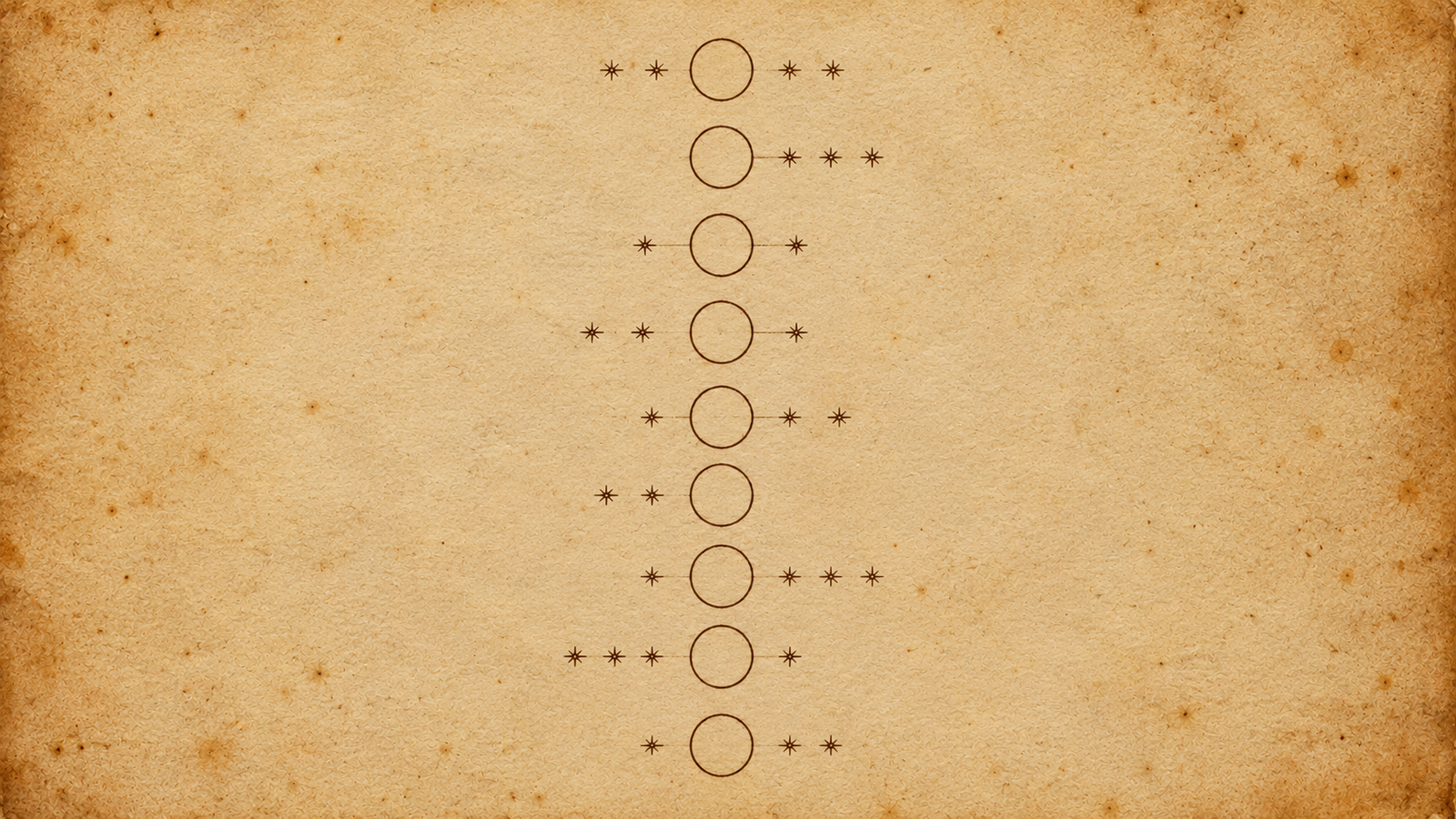
Everything changed on the night of January 7, 1610, when Galileo Galilei pointed a homemade telescope at the planet and noticed four small points of light lined up beside it, shifting position night after night. He had found Io, Europa, Ganymede, and Callisto, the four Galilean moons, and in doing so found the first direct evidence that not everything in the universe orbits Earth.
It is difficult to overstate how much that single observation reshaped human understanding of our place in the cosmos. Galileo logged what he saw across more than 60 small diagrams between January 7 and March 2, 1610, before publishing the discovery in his book Sidereus Nuncius, The Starry Messenger, later that same year.
An Ocean With No Bottom You Could Stand On
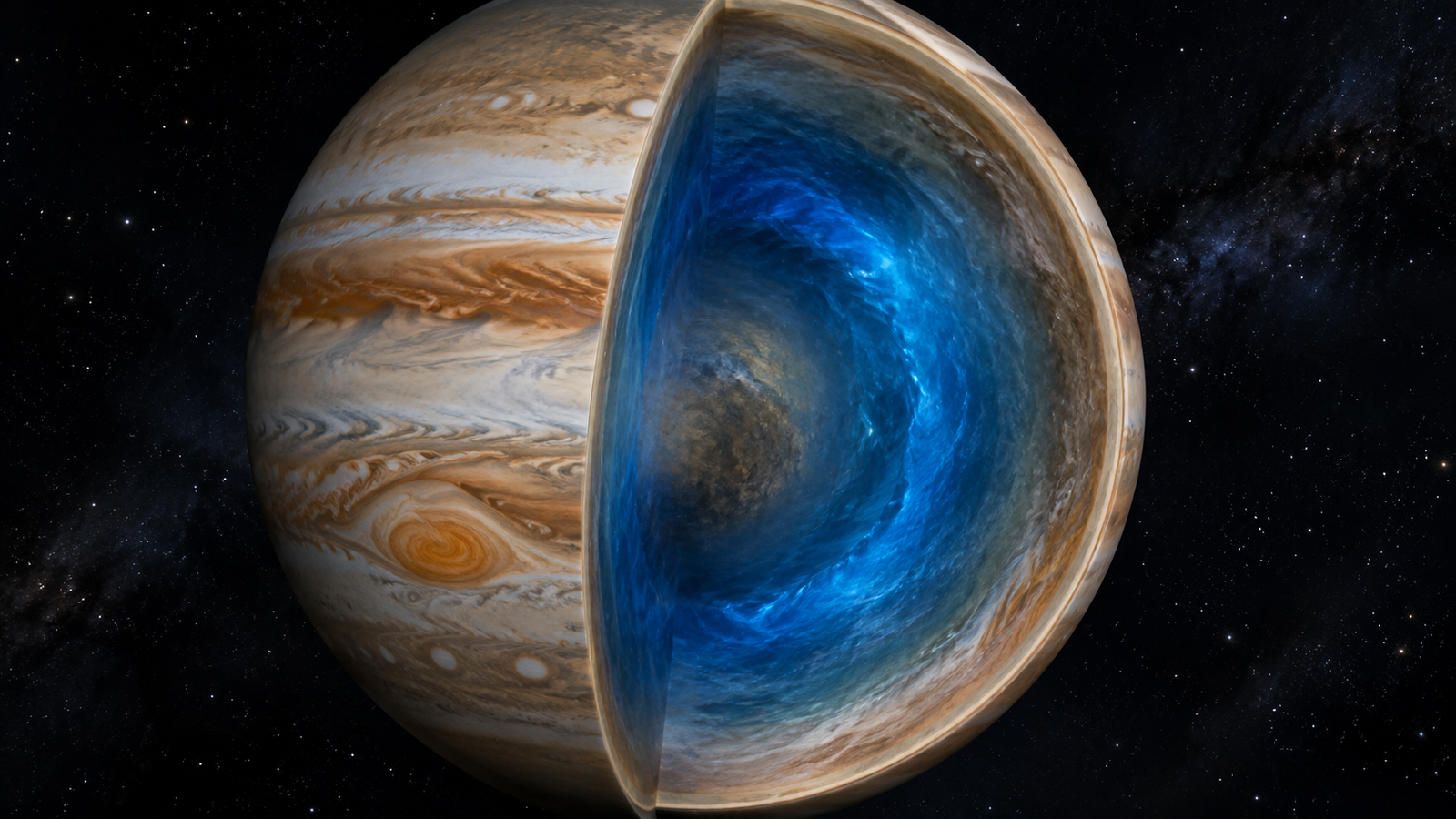
Fall through Jupiter’s atmosphere and you would not hit a surface. You would simply keep falling, through gas that thickens into liquid, through liquid that eventually starts conducting electricity like a metal, for tens of thousands of kilometers before you ever reached anything resembling a core.
Watch the Fall
Jupiter is made almost entirely of hydrogen and helium, the same two elements that make up the sun, which is why it is sometimes called a failed star, though it never came remotely close to having enough mass to ignite. As you descend, the crushing pressure eventually squeezes hydrogen gas into liquid, and deeper still, into a bizarre state called liquid metallic hydrogen, where the fluid conducts electricity. This churning, conductive ocean is the engine behind everything else this planet does.
For decades, textbooks described Jupiter’s interior with a clean three layer model: a small rocky core, wrapped in metallic hydrogen, wrapped in ordinary molecular hydrogen. NASA’s Juno spacecraft, measuring Jupiter’s gravitational field with extraordinary precision since 2016, blew that tidy picture apart.
Juno’s data points to what scientists now call a dilute core, a central region that does not have a sharp boundary at all but instead blends gradually into the surrounding hydrogen envelope, extending out to roughly 63 percent of the planet’s radius according to the models that best match Juno’s measurements, with heavy elements making up only about 18 percent of that region’s mass because they are so thoroughly mixed with the surrounding hydrogen and helium.
How that blended core formed is still an open argument. One idea is that a giant impact early in Jupiter’s history stirred a once compact core into the surrounding hydrogen. A study published in 2025 in Monthly Notices of the Royal Astronomical Society ran detailed impact simulations and found that a single collision could not reproduce the dilute structure Juno actually measured, suggesting the mixing happened more gradually, through the ordinary and much less dramatic process of how the planet accreted material as it formed.
At a Juno science team briefing at the European Geosciences Union’s 2026 assembly, researchers said plainly that Jupiter’s interior is turning out to be far more complicated than anyone modeled even a few years ago.
A Shield That Also Becomes a Weapon
Stand near Jupiter unprotected and the same magnetic field that makes the planet scientifically extraordinary would kill you within hours. That churning ocean of liquid metallic hydrogen generates the most powerful magnetic field of any planet in the solar system, with a magnetic moment, the standard measure of a field’s total strength, roughly 20,000 times greater than Earth’s.
Measured directly at the cloud tops, where the comparison is more immediate, the field still runs 4 to 14 gauss depending on location, against roughly 0.5 gauss at Earth’s own surface. As Jupiter spins, once every 9 hours and 56 minutes, the fastest rotation of any planet, it drags that field around with it, generating enormous electric currents and inflating a magnetosphere so large that, if you could see it from Earth, it would appear several times wider in our sky than the full moon, despite being hundreds of millions of kilometers away.
That magnetosphere traps charged particles into the most intense radiation belts anywhere in the solar system, energetic enough to trap protons at energies over 50 times higher than anything found near Earth. This is not a hospitable neighborhood. Spacecraft engineers design entire mission trajectories around Jupiter specifically to dodge the worst of these belts, and every mission that has ever operated here has had to be hardened against radiation that would fry an unshielded spacecraft’s electronics within a single close pass.
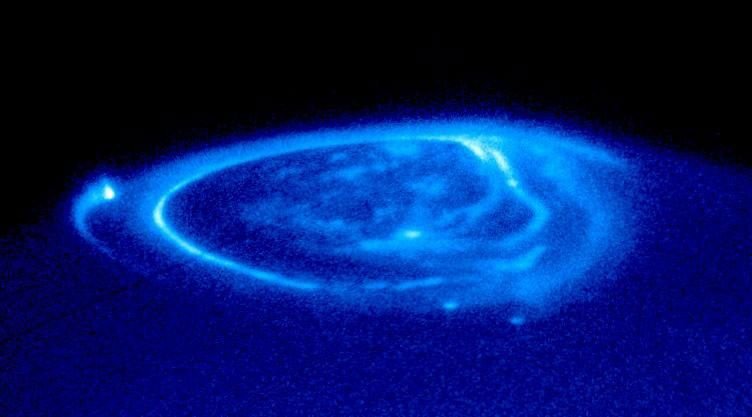
You do not need instruments to see evidence of this system at work. Point a telescope with the right filter at Jupiter’s poles and you would see aurorae far more powerful and persistent than anything Earth produces, and Hubble Space Telescope images have captured something even stranger woven into them: glowing footprints.
Charged particles flowing along magnetic field lines connect Jupiter’s poles directly to three of its largest moons, Io, Europa, and Ganymede, each one leaving its own distinct auroral signature burned into Jupiter’s upper atmosphere, a visible, glowing tether between planet and moon that Earth has no equivalent of anywhere in its own system.
A Storm Older Than Photography Itself
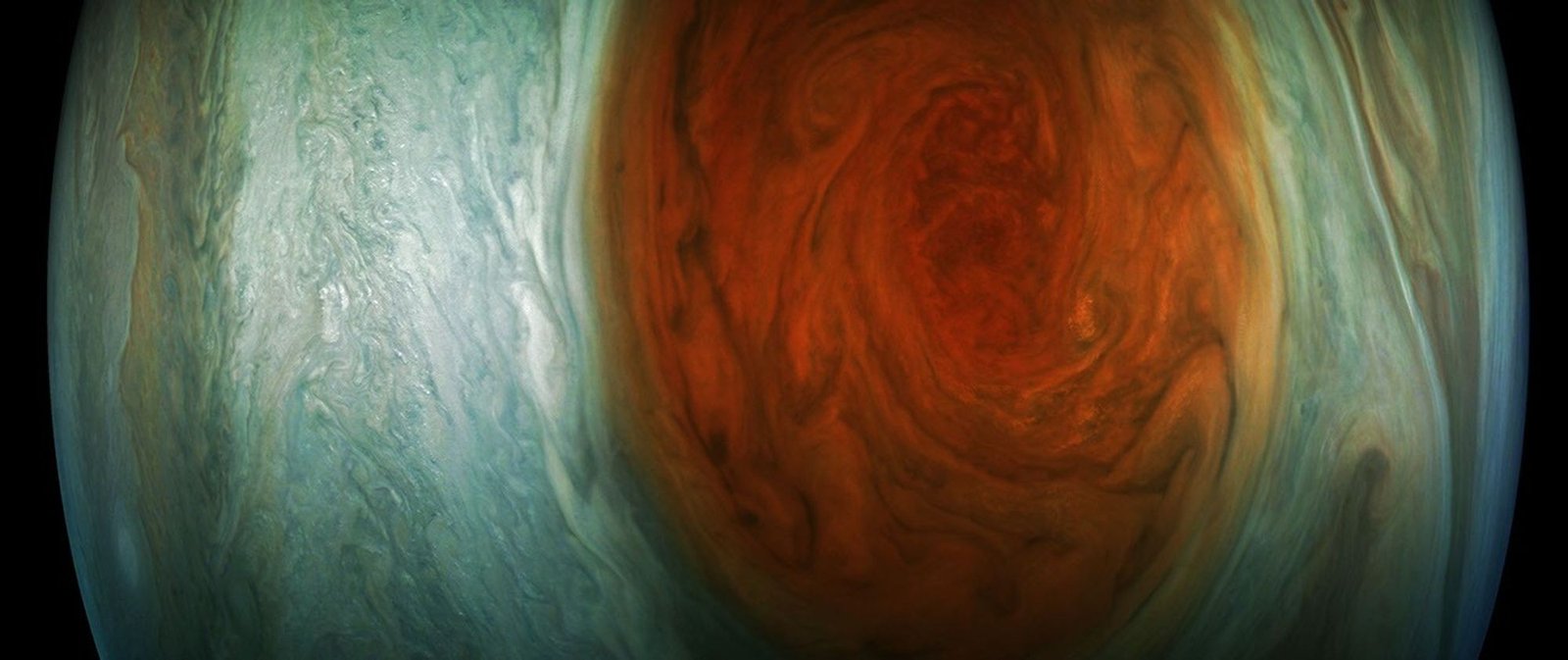
Somewhere in Jupiter’s southern hemisphere, a storm has been spinning continuously since before anyone alive today was born, before the invention of the airplane, before most of the countries currently on Earth’s map existed as nations. The Great Red Spot is an anticyclone, a high pressure vortex rotating counterclockwise, and reliable tracking of it goes back to at least 1831, with less certain sightings pushing that further back still.
It has never been a fixed size. In 1879, astronomers measured its long axis at roughly 39,000 kilometers, wide enough to fit three Earths side by side. When Voyager 1 and 2 flew past in 1979, it had already narrowed to about 23,000 kilometers. Today, careful tracking by the Hubble Space Telescope puts it at roughly 14,000 to 16,000 kilometers across, only a little wider than Earth itself, and its shape has grown steadily more circular as it has shrunk.
Nobody knows why the shrinking is happening, and nobody can responsibly predict when, or whether, it will stop.
You might assume something this famous would be fully understood by now. It is not. A 2024 Hubble monitoring campaign discovered that the Great Red Spot oscillates in size over a roughly 90 day cycle, squeezing in and out like a stress ball, to borrow NASA’s own headline, in a pattern lead researcher Amy Simon said had not been identified before.
And in 2024, a separate team led by Agustín Sánchez-Lavega examined centuries of historical drawings and made a genuinely surprising argument: the storm European astronomers called the “Permanent Spot,” tracked from 1665 to 1713, was most likely a completely different storm from the Great Red Spot you see today, one that vanished for over a century before the modern spot emerged sometime before 1831. What feels like one continuous 350 year old storm may actually be the second act of a story that started, ended, and started again.
Juno finally answered a different question that had puzzled scientists for over a century: how deep does it go? Juno’s microwave instrument traced the storm’s roots down more than 300 kilometers, and gravity measurements collected during twelve close flybys, including two direct overflights of the storm itself, put the deepest possible limit at about 500 kilometers below the visible cloud tops, a result that would have been impossible without a spacecraft actually flying directly above it.
Four Moons, Four Completely Different Planets in Miniature
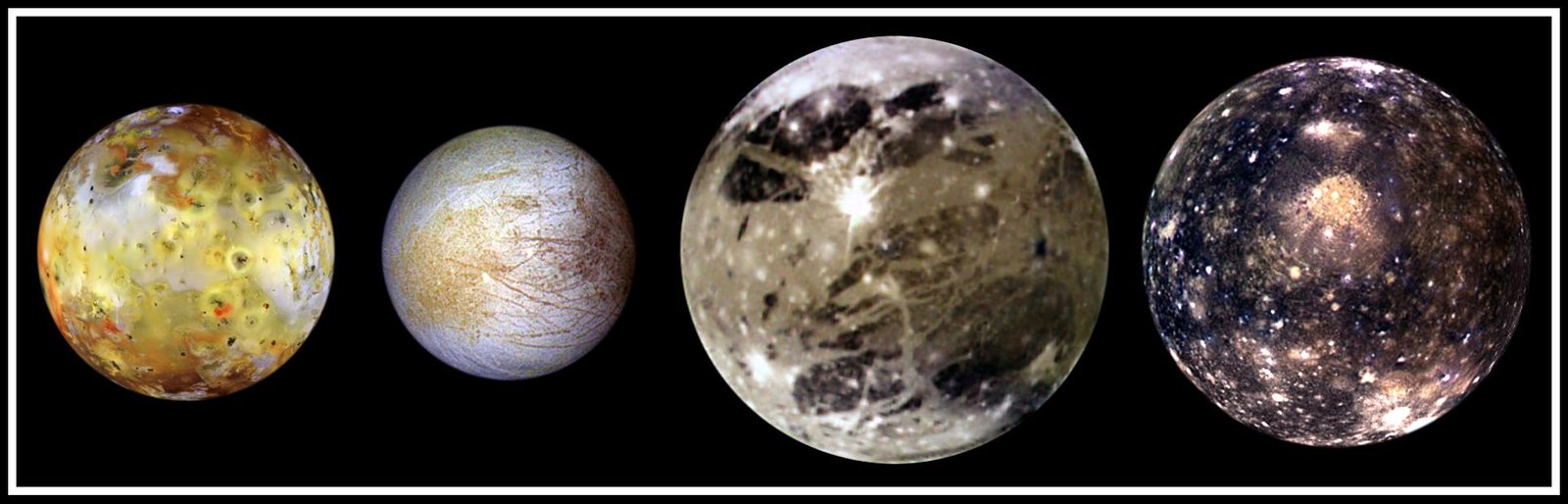
Look toward Jupiter with binoculars on a clear night and you can see, faintly, the same four points of light Galileo saw in 1610. Each one is, in its own right, a genuinely strange world, and none of them resemble each other even slightly despite orbiting the same planet within a few million kilometers of one another.
Io, the innermost of the four, is the most volcanically active body anywhere in the solar system, more active than Earth itself. It has no volcanoes that sit quietly. Sulfurous eruptions constantly resurface its entire crust, driven not by an internal furnace like Earth’s but by tidal heating, the relentless gravitational tug of war between Jupiter and the other Galilean moons flexing Io’s interior like a stress ball squeezed hundreds of times a second.
Europa, next out, could not look more different. Its surface is a shell of water ice, crisscrossed by long, dark cracks, and underneath that ice sits a global ocean of liquid water, kept from freezing solid by the same tidal flexing that torments Io, only gentler here. Because Jupiter’s magnetic field passes directly through that hidden saltwater ocean, it induces a small magnetic signal of its own, one of the strongest pieces of evidence scientists have that the ocean is really there. Europa is widely considered one of the most promising places to search for life anywhere beyond Earth.
Ganymede is the largest moon in the entire solar system, bigger than the planet Mercury, and the only moon known to generate its own internal magnetic field, carving out a small magnetic bubble of its own nested inside Jupiter’s much larger one. Callisto, the outermost of the four, is the most heavily cratered object in the solar system, a surface so ancient and undisturbed that it may have gone essentially unchanged for four billion years, and evidence suggests it too may hide a salty ocean beneath its beaten, ice covered crust.
A Fainter Ring System, Hiding in Plain Sight
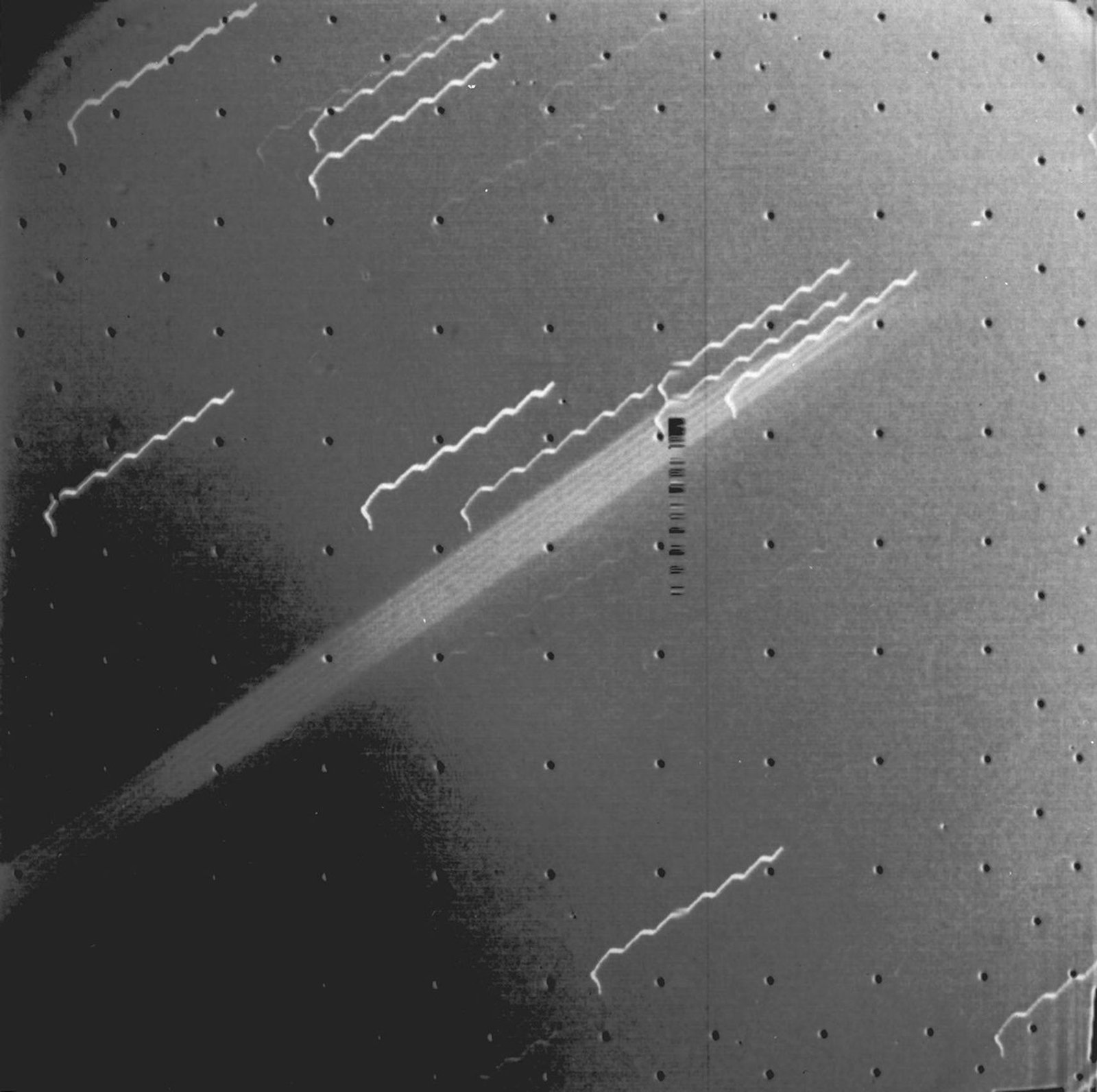
Saturn is not the only planet wearing rings. Jupiter has its own, discovered only on March 4, 1979, when Voyager 1 captured a single, deliberately planned 11 minute exposure aimed at the planet’s equatorial plane and caught a faint band of light nobody had ever confirmed before.
Unlike Saturn’s bright, icy rings, Jupiter’s are made of fine, dark dust, likely kicked up by micrometeorite impacts against its smaller inner moons, and the ring itself is estimated to be no more than 30 kilometers thick. They are so faint and so transparent from any angle except edge on that they went completely unnoticed from Earth for the entire history of telescopic astronomy until that single targeted photograph proved they were real.
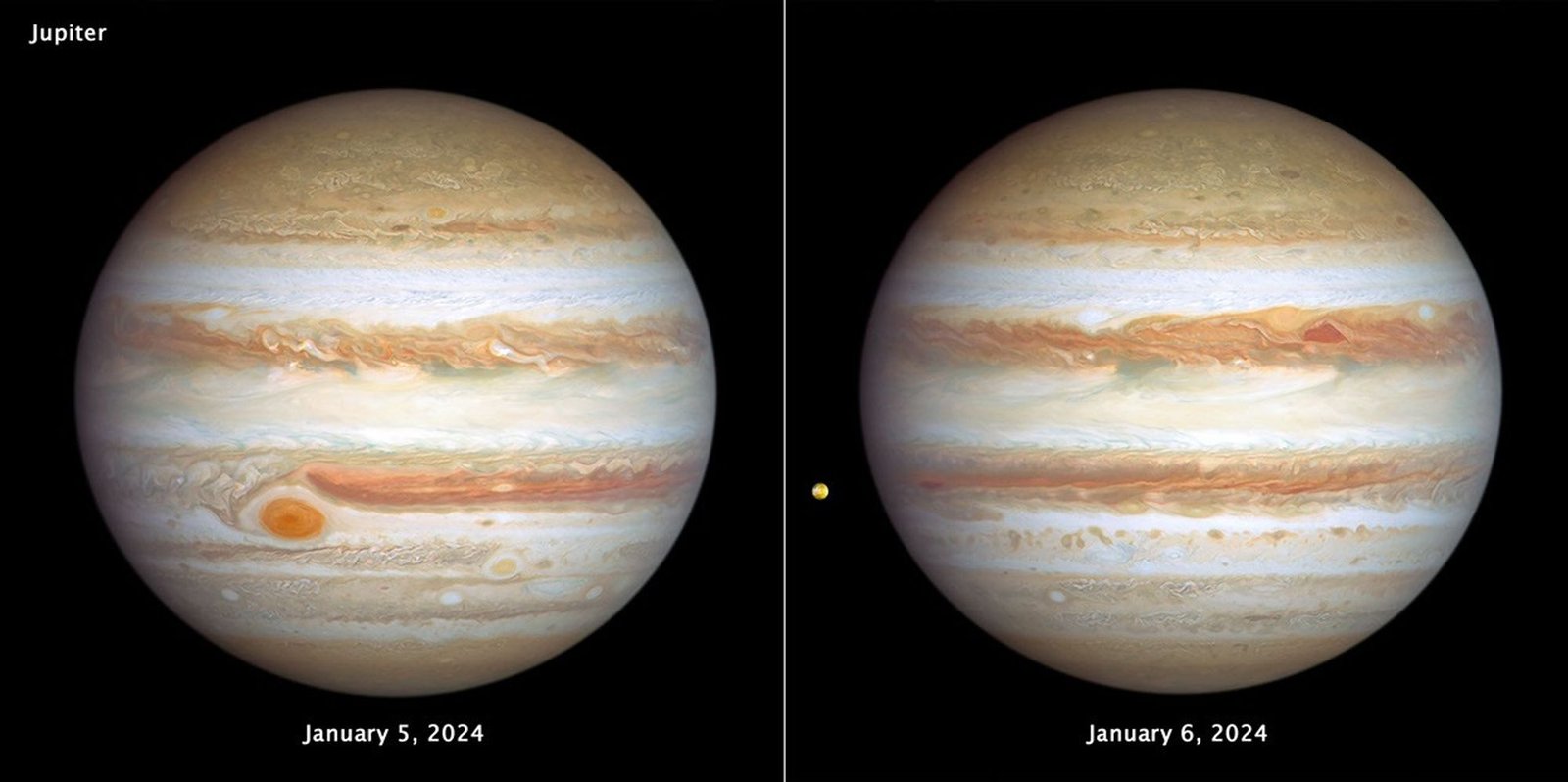
Above and below those rings, Jupiter’s atmosphere never sits still. The banded pattern you see in every photograph, alternating light zones and dark belts, is the visible signature of jet streams moving in opposite directions, with NASA measuring some of the strongest reaching up to 539 kilometers per hour, among the fastest sustained winds anywhere in the solar system. Juno’s gravity measurements later showed, in NASA’s 2018 release on the findings, that these jets are not just a surface feature.
At low latitudes they reach roughly 3,000 kilometers down into the planet before fading out. Where neighboring bands rub against each other, the turbulence spawns storms constantly, and some of them, like the long lived white ovals near the Great Red Spot that have persisted since the 1930s, can last for generations before finally dissipating.
The Great Red Spot is not even alone in its own neighborhood. A smaller reddish anticyclone nicknamed Red Spot Jr, formed when storms merged in 1998 and 2000, passes the Great Red Spot roughly once every two years, the two storms staying in their own separate lanes as they do.
Six Spacecraft, and One Whose Fate Is Still Unclear
Human understanding of Jupiter has advanced almost entirely through a small handful of robotic missions, each one rewriting what came before it. Pioneer 10 and 11 made the first flybys in 1973 and 1974, surviving a radiation environment nobody had ever tested a spacecraft against before. Voyager 1 and 2 followed in 1979, delivering the first detailed images of the Great Red Spot and discovering both Jupiter’s faint rings and active volcanism on Io, a genuine surprise at the time.
Galileo arrived in 1995 and became the first spacecraft to orbit Jupiter directly, spending eight years studying the planet and its largest moons up close, and it was Galileo’s data that first suggested hidden oceans beneath the ice of Europa, Ganymede, and Callisto. NASA’s Juno spacecraft arrived in July 2016 and has spent the years since rewriting the interior structure models scientists have relied on for decades, using gravity and magnetic field measurements no earlier mission could obtain.
Here is where the story gets uncertain in a way that is worth being honest about. Juno’s most recent mission extension was guaranteed only through September 30, 2025.
That date has now passed, and a funding lapse tied to a United States government shutdown left the mission’s status unconfirmed for a period afterward, with the spacecraft’s operating budget zeroed out in one federal budget proposal. As of this writing, whether Juno is still returning data is genuinely unclear, and that uncertainty matters, because ending the mission early would leave a gap in dedicated Jupiter observations stretching until the next spacecraft arrives.
That next spacecraft is already on its way. NASA’s Europa Clipper launched October 14, 2024, and is due to arrive at Jupiter on April 11, 2030, after a five and a half year journey using gravity assists from both Mars and Earth. Once there, it will make 49 close flybys of Europa specifically, some as close as 25 kilometers above the surface, studying whether that hidden ocean could actually support life.
The European Space Agency’s JUICE spacecraft, launched April 14, 2023, will arrive in the Jupiter system in July 2031 and eventually become the first spacecraft ever to orbit a moon other than our own, settling into orbit around Ganymede in December 2034. For the first time, two major spacecraft will study the Jovian system at once.
The Open Questions
Jupiter has been studied by spacecraft for over fifty years, and it still keeps secrets. Nobody fully understands why the Great Red Spot is shrinking, or whether it will stabilize, keep shrinking indefinitely, or eventually break apart entirely.
Nobody has definitively located where inside the planet its magnetic dynamo actually operates, only that the field looks lumpier and more complex up close than any model predicted. And nobody yet knows for certain whether Europa’s or Callisto’s hidden oceans actually contain the ingredients life would need, a question two separate spacecraft are now racing across the solar system to help answer.
The Strangest Jupiter Facts to Take With You
- Jupiter has no solid surface anywhere. Every photograph ever taken of it shows only clouds
- Its magnetic field is roughly 20,000 times stronger than the one protecting Earth
- The Great Red Spot has been tracked continuously since at least 1831, and may be the second storm of its kind to occupy that same latitude
- Jupiter’s day is under 10 hours long, making it the fastest spinning planet in the solar system despite being the largest
- One of its moons, Io, is more volcanically active than Earth, while another, Europa, may hide more liquid water than every ocean on Earth combined
- Its faint ring system went undiscovered until a spacecraft flew close enough in 1979 to see it directly
FAQ
What are the most important Jupiter facts? Jupiter has no solid surface, a magnetic field roughly 20,000 times stronger than Earth’s, a storm that astronomers have tracked since 1831, and 115 known moons, including Europa, which may hide a global ocean. These Jupiter facts come from decades of spacecraft data, most recently from NASA’s Juno mission.
Does Jupiter have a solid surface? No. Of all the Jupiter facts people search for, this is the most surprising. The planet is made almost entirely of hydrogen and helium gas that gradually transitions into liquid, then into an exotic conductive state called liquid metallic hydrogen, with depth. There is no solid ground anywhere a spacecraft, or a person, could stand.
Why is Jupiter’s magnetic field so strong? Deep inside Jupiter, immense pressure compresses hydrogen into liquid metallic hydrogen, a fluid that conducts electricity. Combined with Jupiter’s extremely fast rotation, under 10 hours per day, this churning conductive ocean generates a magnetic field roughly 20,000 times stronger than Earth’s, the strongest of any planet in the solar system.
Is the Great Red Spot shrinking? Yes, and it is one of the most quoted Jupiter facts. In the late 1800s it measured roughly 39,000 kilometers across, wide enough for three Earths. Today it measures roughly 14,000 to 16,000 kilometers, only slightly wider than Earth itself. Scientists do not know why the shrinking is happening or whether it will stop.
How many moons does Jupiter have? As of August 2026, Jupiter has 115 confirmed moons, the Jupiter fact that changes most often, a number that has climbed quickly in recent years and will likely rise again as survey technology improves. The four largest, Io, Europa, Ganymede, and Callisto, were the first discovered and remain by far the most studied, having been found by Galileo Galilei in 1610.
Could there be life on one of Jupiter’s moons? Nobody knows yet. Europa and possibly Callisto are believed to hide global oceans of liquid water beneath their icy shells, and Europa in particular is considered one of the most promising places in the solar system to search for life. NASA’s Europa Clipper mission, arriving in 2030, is specifically designed to investigate that question.
Does Jupiter have rings? Yes, though they are much fainter than Saturn’s. Jupiter’s ring system was not discovered until Voyager 1 flew past in 1979 and photographed it directly, since it is too faint and made of dust too dark to be seen from Earth.
Is NASA’s Juno mission still operating at Jupiter? This is genuinely uncertain. Juno’s most recent guaranteed mission extension expired on September 30, 2025, and a funding lapse connected to a United States government shutdown left the mission’s continued operation unconfirmed afterward. Readers should check current NASA mission status pages for the latest update.
Why Jupiter Still Matters
Jupiter is often introduced to people as the biggest planet, a fact that undersells what actually makes it remarkable. It is a world with no surface, a magnetic field powerful enough to be dangerous from far away, and a storm that has likely outlived every person who has ever studied it. Four small moons orbiting it turned out to be four entirely different kinds of worlds, one of which may be hiding more water than every ocean on Earth combined.
Jupiter did not simply grow large and stop. It shaped the orbits of everything else in the early solar system, and in many ways it is still shaping how scientists understand what a planet is even allowed to be. The closer spacecraft look, the less settled the picture becomes, and that, more than its size, is what makes it worth returning to again and again.
There Are Seven More Worlds Like This One
You have just stood inside a planet with no floor, watched a storm older than the telescope that first found it, and traced a magnetic field powerful enough to end a life it never even touched. Jupiter is not an outlier. It is one entry in a solar system built almost entirely out of surprises like this one, and the rest of them are still waiting. A scorched world baked by its own closeness to the sun sits closer than you think. A canyon that could swallow a continent is already behind you. Keep going. The next world is never the one you expect.
Explore more worlds in the From Worlds Beyond Solar System section →