
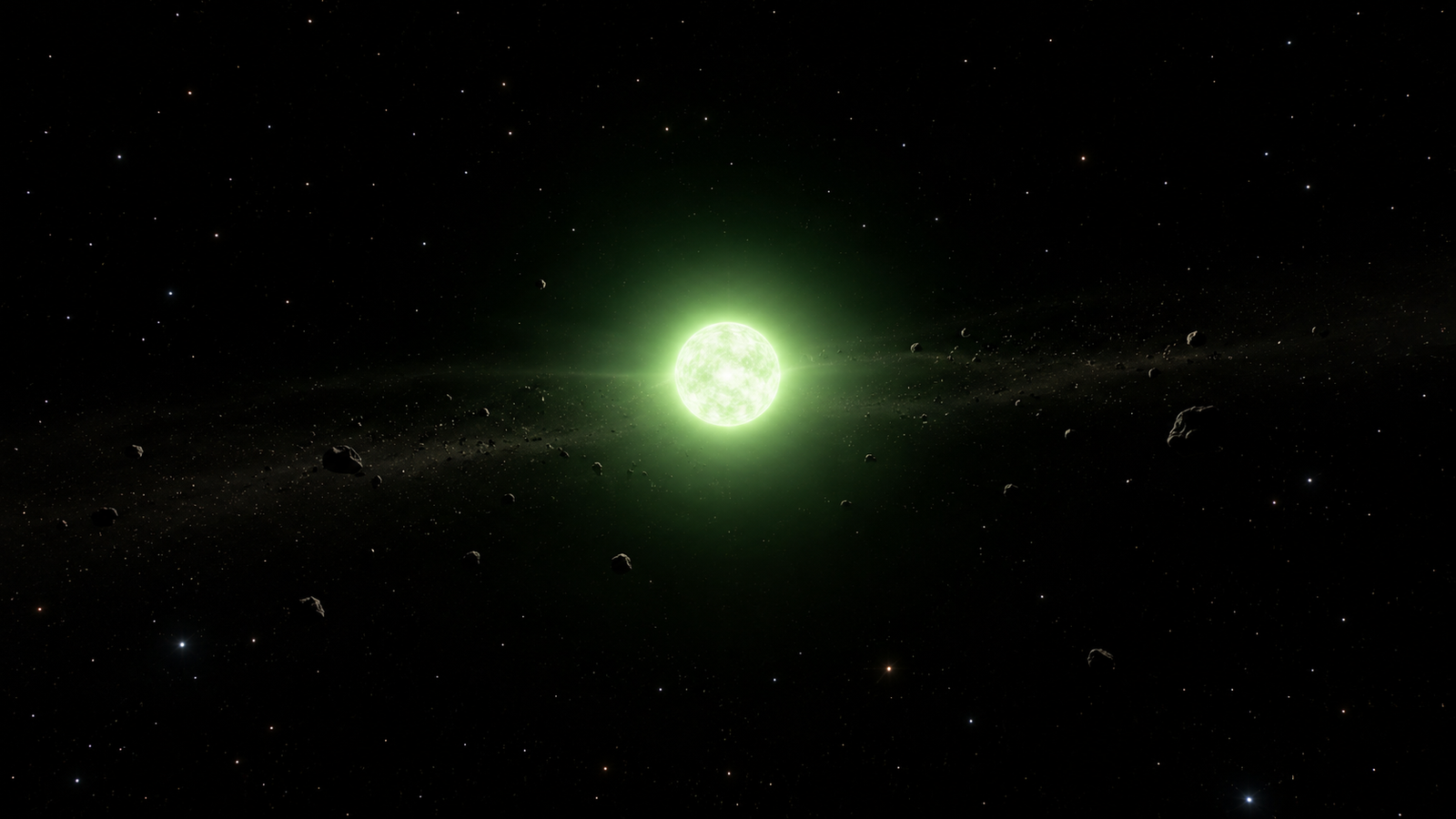
Imagine standing on a distant world and looking up at a green sun. Not a special effect. Not science fiction. A real star.
For most of human history, the colours of stars seemed predictable. Cooler stars appear orange or red. Stars like our Sun appear white. The hottest stars shine blue.
But green? That colour seemed to be missing from the Universe. Now astronomers have identified something that may finally change that.
It is called WD J1330+6435, an ancient white dwarf located roughly 280 light years from Earth. According to new research from the University of Warwick, this strange stellar remnant would appear chartreuse green to the human eye if we could see it up close.
And the reason it became green is even stranger than the discovery itself.
What Is the Green Star?
WD J1330+6435 is not an ordinary star. It is a white dwarf, the incredibly dense remnant left behind after a star similar to our Sun reaches the end of its life.
When such a star runs out of fuel, it eventually sheds its outer layers and leaves behind its exposed core. That remnant can remain extraordinarily hot and dense for billions of years as it slowly cools.
But WD J1330+6435 has something unusual in its atmosphere.
Astronomers believe it has accumulated rocky material from the remains of its old planetary system. That material enriched its atmosphere with elements including calcium, lithium and sodium.
Under the extreme conditions surrounding this dead star, those elements do something remarkable. They change its colour.
According to the University of Warwick researchers, WD J1330+6435 is the first known star that would appear genuinely green to human eyes. The research was published in the scientific journal RAS Techniques and Instruments. The University of Warwick’s official research announcement explains how the team calculated these extraordinary colours.
Why Is This Star Green?
For most stars, colour is closely connected to temperature. A very hot star emits more strongly at shorter wavelengths and can appear blue. Cooler stars shift toward orange and red.
White dwarfs can break that simple rule. Their atmospheres can become extraordinarily dense. In WD J1330+6435, sodium exists inside an environment very different from the atmosphere of an ordinary star.
The immense density changes how sodium interacts with light.
Instead of affecting only a narrow part of the visible spectrum, sodium in this extreme environment can absorb light over a much broader range, particularly across yellow, orange and red wavelengths.
What remains changes the colour that would reach a human eye. The result is extraordinary. A ghostly chartreuse green star.
In other words, the green colour is not caused by the star somehow producing green fire. It is created because the chemistry of its incredibly dense atmosphere selectively changes the light escaping into space.
How Did Astronomers Know It Was Green?
This is one of the most important parts of the discovery. Astronomers did not point a telescope at WD J1330+6435 and directly see a large green sphere. The star is far too distant and small to appear as a visible disc from Earth.
Instead, researchers studied its spectrum. A spectrum separates starlight into different wavelengths, revealing a detailed fingerprint of the light produced by an object.
The researchers then used models of human colour vision to calculate how that measured light would actually appear to human eyes. That allowed scientists to move beyond simply describing the star’s temperature and chemical composition.
They could ask a surprisingly direct question.
What colour would this star actually look like?
For WD J1330+6435, the answer was green.
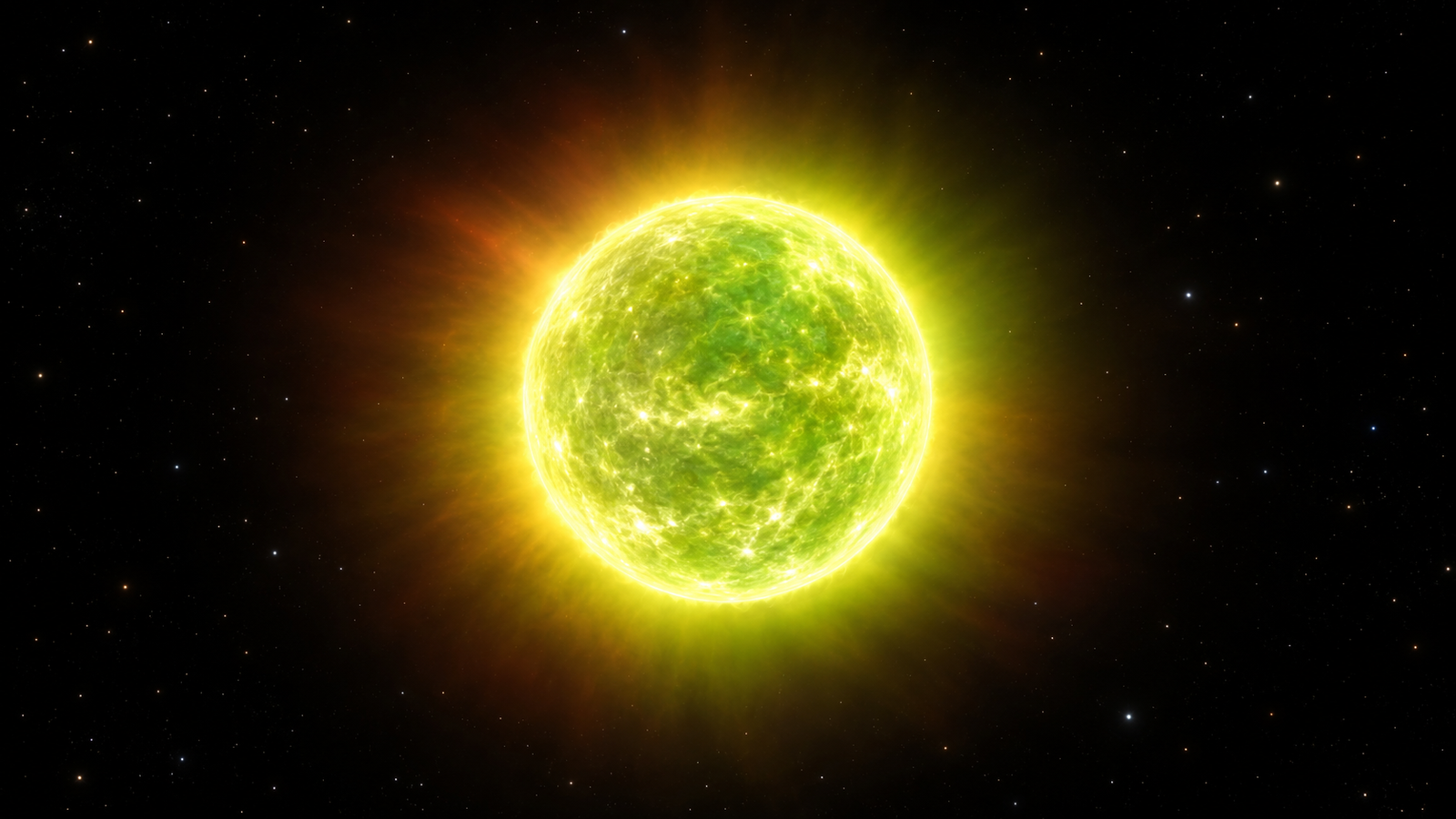
Can a Star Really Be Green?
According to the researchers, yes. But there is an important reason why green stars have been so difficult to identify.
Normal stars behave approximately like objects whose colours are dominated by temperature. Their light spreads broadly across the visible spectrum. To appear strongly green, something unusual has to happen.
A star would need its atmosphere to selectively alter enough other visible wavelengths for green light to dominate what human eyes perceive. That is exactly what makes WD J1330+6435 so extraordinary.
Its extreme density and unusual atmospheric chemistry create conditions that ordinary stars do not have. The University of Warwick researchers say that, as far as they are aware, no other living or dead star has previously been credibly reported as green.
This may be the first known genuinely green star in the Galaxy.
A Dead Star Changed by Its Own Planetary System
The green colour may tell us something even deeper about this star’s history.
White dwarfs can pull in material from objects that once orbited them. When asteroids, rocky bodies or the remnants of former planets are disrupted, some of that material can fall toward the dead star.
WD J1330+6435 appears to have accumulated rocky material containing elements such as sodium, calcium and lithium. Those elements became part of its atmosphere.
And billions of years after the original star died, the remains of its planetary system may now be changing the way the dead star looks.
There is something almost unsettling about that. A star dies. Its planetary system begins to break apart.
And the remains of those worlds may return to the dead star and change its colour.
The Green Star Is Part of a Much Stranger Discovery
WD J1330+6435 was not the only unusual object revealed by the research. The same study showed that some white dwarfs could appear in colours including pink, purple, yellow and cyan.
That includes the extraordinary salmon pink white dwarf discussed in our earlier From Worlds Beyond article.
READ NEXT: Astronomers Just Found a Pink Star and It Is Changing What We Know About Dead Stars
Carbon rich white dwarfs can appear pink or purple. White dwarfs affected by material from disrupted planetary systems can develop other unusual colours. Extremely dense atmospheres can reshape starlight in ways astronomers did not fully appreciate before.
The Universe may contain stellar remnants far more colourful than we once imagined. Yet there is another surprising result.
On average, white dwarfs are still white. The researchers examined a representative sample of nearby white dwarfs and found that unusual colours were rare. Most remained close to white.
Which makes the green one even more extraordinary.
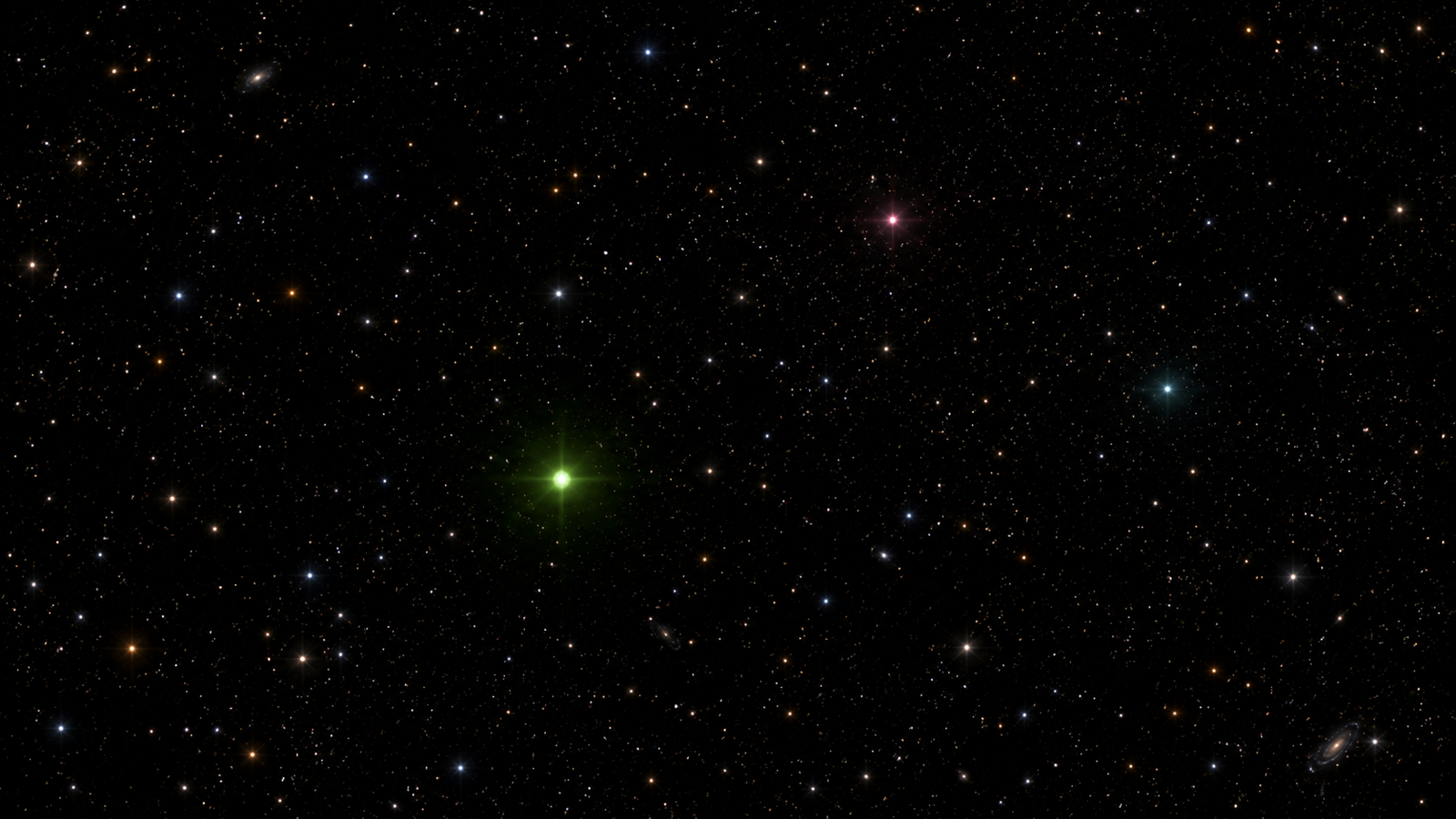
Could You See the Green Star From Earth?
No.
WD J1330+6435 is far too faint and distant for human eyes to see as a green disc in the night sky. In fact, its green appearance comes from analysing its spectrum and calculating how its light would be perceived if we could view the stellar surface directly.
So the dramatic images representing the green star are scientific visualizations, not telescope photographs showing a giant green sphere floating in space.
That distinction matters. The science is real. The colour calculation is real.
But the visual appearance has been reconstructed from the star’s measured light. NASA’s Astronomy Picture of the Day also describes its featured image as an illustration rather than a direct photograph.
What This Discovery Changes
For decades, stellar colour seemed like one of the simplest things in astronomy. Look at a star. Determine its colour. Learn something about its temperature.
WD J1330+6435 reminds us that reality can be more complicated. In the extreme environments surrounding white dwarfs, temperature is not the only thing shaping the light that escapes into space.
Density matters. Chemistry matters. The remains of destroyed worlds may matter.
And under the right conditions, all of them together can create something that once seemed impossible.
A green star.
Frequently Asked Questions
Did astronomers really find a green star? Astronomers identified the white dwarf WD J1330+6435 as the first known star that would appear genuinely green to human eyes based on calculations using its measured spectrum and models of human colour perception.
What is the green star called? The object is called WD J1330+6435.
Why is WD J1330+6435 green? Its extremely dense atmosphere contains material including sodium that changes how visible light is absorbed. The result is a calculated chartreuse green appearance.
Was the green star directly photographed? No. Astronomers calculated its appearance from spectral data and models of human colour perception. Images showing it as a large green sphere are scientific or artistic visualizations.
How far away is the green star? WD J1330+6435 is roughly 280 light years from Earth.
Can you see a green star from Earth? Not directly as a visible green disc. WD J1330+6435 is too faint and distant, and its calculated green colour comes from analysis of its measured spectrum.
Are there other unusually coloured stars? Yes. The same research found white dwarfs that could potentially appear pink, purple, yellow and cyan, depending on their atmospheric chemistry and extreme physical conditions.
Explore More From Worlds Beyond
If you want to continue exploring discoveries that challenge what we thought we knew about the Universe, read:
Astronomers Just Found a Pink Star and It Is Changing What We Know About Dead Stars
Could Other Universes Exist Beyond Our Own?
The Universe is not always what it appears to be.
Sometimes, it is stranger.