
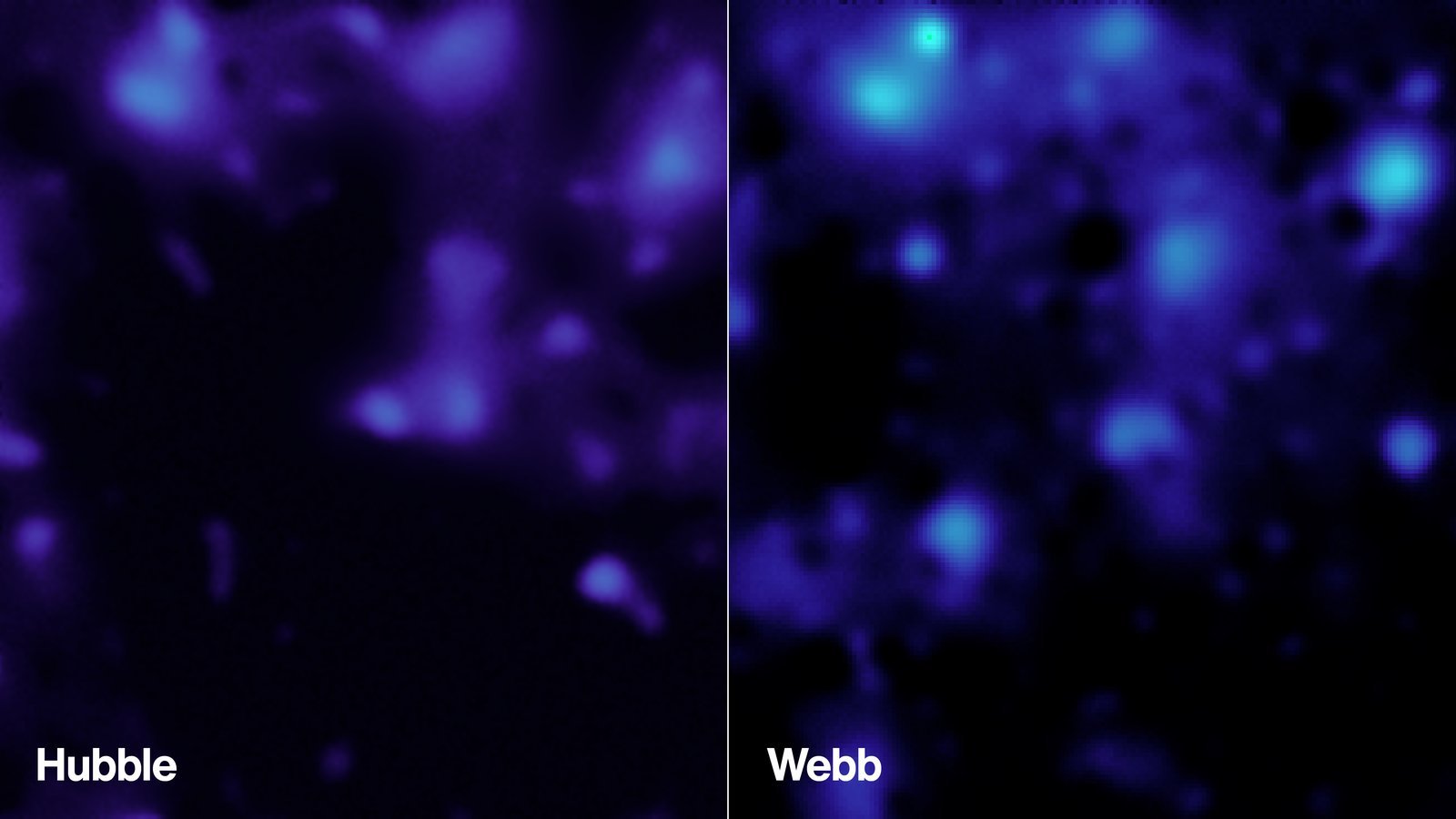
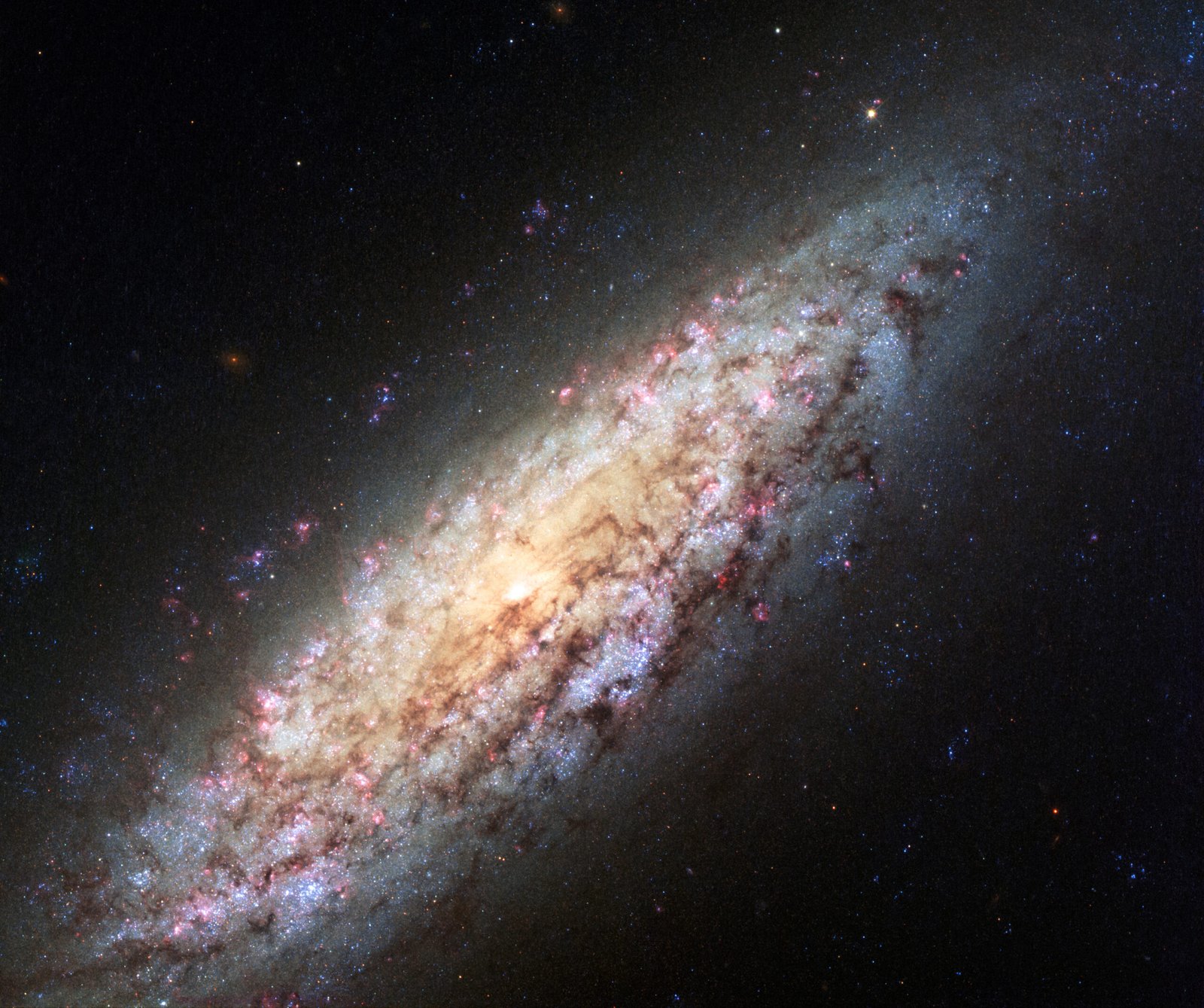
You are standing inside a galaxy that should not be able to hold itself together.
Every star orbiting its center is moving fast enough that it ought to fly off into the dark, the way a stone flies off a sling the moment you let go of the string. Gravity from the stars and gas you can actually see is nowhere near strong enough to keep that spinning disk intact. And yet it stays together, year after year, orbit after orbit, as if some unseen hand were holding the whole structure in place.
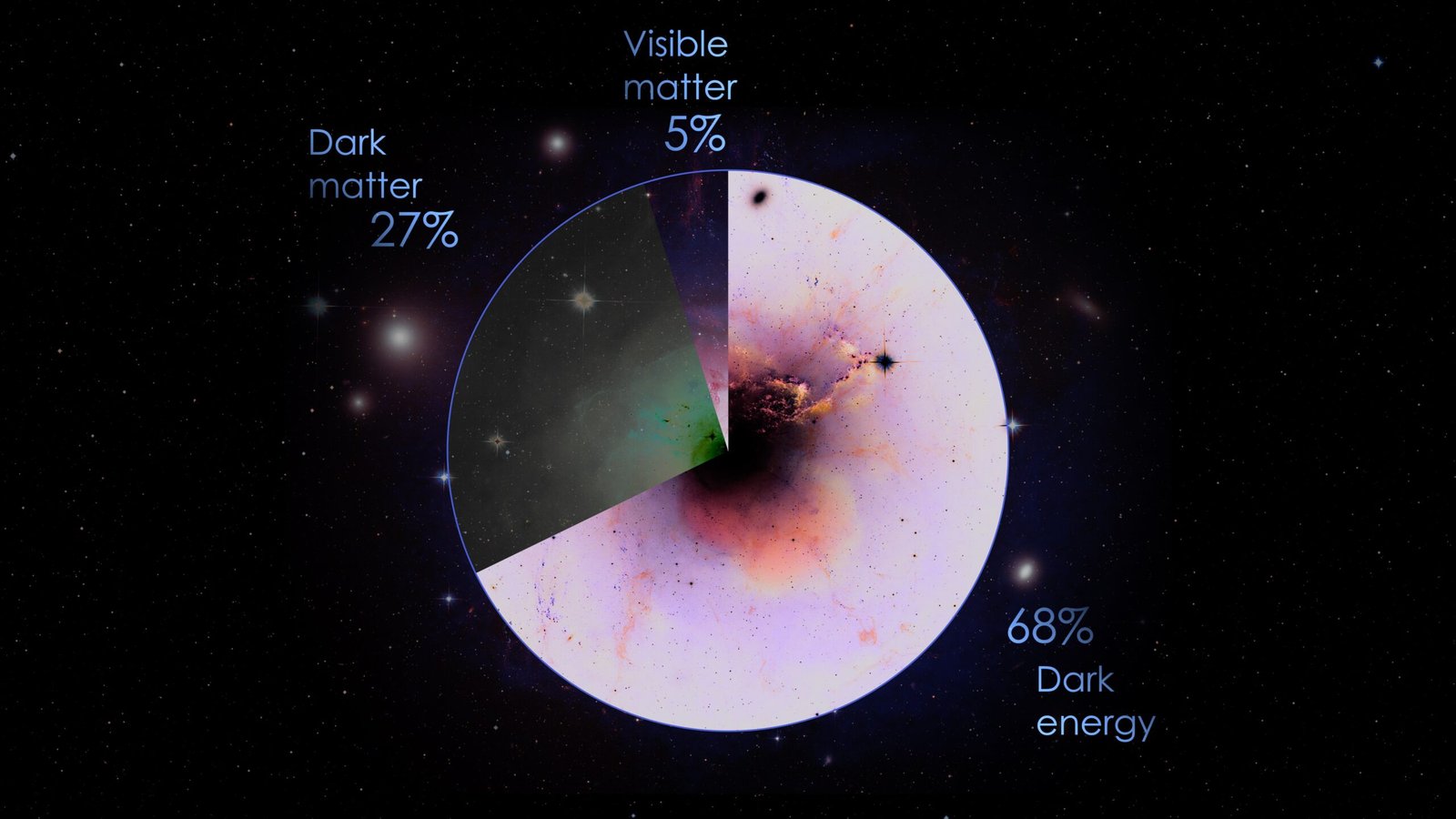
For nearly a century, scientists have called that unseen hand dark matter. According to NASA, it makes up roughly 27 percent of everything in the universe, which means it outweighs all the stars, planets, and galaxies you can see by more than five to one. We have mapped where it sits. We have watched it bend starlight around galaxy clusters. We have even caught it tearing itself apart during a collision between two clusters millions of light years away. The one thing nobody has ever done is actually find it.
Now a widely recognized physicist is suggesting that we may have been looking for the wrong thing entirely. Michio Kaku, cofounder of string field theory and one of the most prominent voices in theoretical physics, has proposed that dark matter might not be matter in any conventional sense. It might be gravity itself, leaking into our universe from somewhere we cannot see or touch. A parallel universe, sitting just beyond our own, close enough that its gravity reaches us even though nothing else about it ever could.
It sounds like science fiction. Large parts of it are still speculation. But the physics underneath it is real, and understanding it means understanding one of the strangest unanswered questions in modern cosmology, why gravity is so astonishingly weak compared to every other force in nature.
What We Actually Know About Dark Matter
| Fact | Detail |
|---|---|
| What dark matter is | An invisible substance that interacts through gravity but does not emit, absorb, or reflect light |
| Share of the universe | Roughly 27 percent of all mass and energy in the universe, compared to about 5 percent ordinary matter |
| First proposed | 1933, by astronomer Fritz Zwicky, while studying the Coma galaxy cluster |
| Strongest evidence | Flat galaxy rotation curves, gravitational lensing, and the Bullet Cluster collision |
| Leading particle candidates | WIMPs and axions, neither of which has ever been directly detected |
| Kaku’s proposal | Dark matter may not be a particle at all, but the gravitational influence of matter in a parallel universe leaking across higher dimensions |
| Scientific status | A serious but unconfirmed hypothesis within string theory and brane cosmology, not a mainstream consensus explanation |
What dark matter actually is, and what it is not
Before getting to Kaku’s idea, it helps to be precise about what dark matter is, because the name itself causes confusion. Dark matter is not a cloud of dark colored dust. It is not simply matter that happens to be hard to see. As far as every experiment to date can tell, dark matter does not interact with light at all, not by absorbing it, not by reflecting it, not by emitting it. The only way we know it exists is through its gravity.
That evidence is not thin. In the 1970s, astronomer Vera Rubin measured how fast stars orbit at the outer edges of spiral galaxies, expecting them to slow down the farther they were from the crowded galactic center, the same way planets further from the Sun orbit more slowly. Instead, the rotation curves came back essentially flat. Stars at the edge of a galaxy were moving just as fast as stars near the middle, which should be physically impossible unless an enormous amount of unseen mass was spread through the galaxy’s outer halo, pulling everything along with it.
Gravitational lensing confirmed the pattern on an even larger scale. When light from a distant galaxy passes near a massive foreground cluster, the cluster’s gravity bends that light, distorting and sometimes duplicating the image behind it. By measuring exactly how much the light bends, astronomers can calculate how much mass the cluster actually contains, and that number consistently comes out far higher than the visible galaxies could account for on their own.
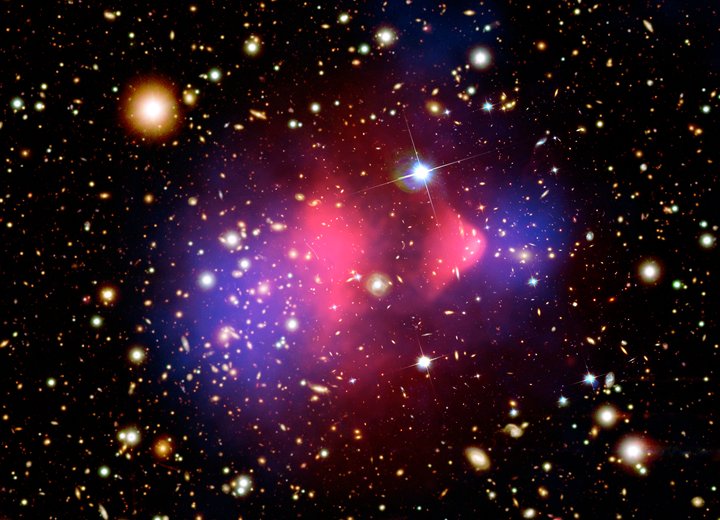
The most dramatic piece of evidence came from the Bullet Cluster, the site of a collision between two massive galaxy clusters. When clusters collide, their visible gas slows down and piles up in the middle, the way two crowds of people colliding would bunch together at the point of impact. But when astronomers mapped where the gravity was actually concentrated using lensing, it was not in the slowed down gas at all. It had kept moving straight through the collision, separated cleanly from the visible matter. Whatever was carrying that mass was not interacting with anything except through gravity, exactly what you would expect from dark matter, and very hard to explain any other way.
The decades long hunt for a dark matter particle
For most of the last fifty years, the leading explanation has been that dark matter is made of an undiscovered particle, something that exists but simply does not interact with light or ordinary matter the way protons and electrons do.
Two candidates have dominated the search. The first is the WIMP, short for weakly interacting massive particle, a hypothetical particle that would barely interact with anything except through gravity and the weak nuclear force. The second is the axion, an even lighter theoretical particle originally proposed to solve an unrelated problem in particle physics, which turned out to have properties that could also explain dark matter.
Both have been hunted relentlessly, including by experiments such as the LUX ZEPLIN detector buried nearly a mile underground in South Dakota, shielded from cosmic rays that would otherwise drown out any possible signal. Particle colliders have smashed protons together at nearly the speed of light, and resonant cavities have been tuned to catch the faint signature of an axion converting into a photon. As of 2026, none of these experiments has produced a confirmed detection. Each new result narrows the range of places a WIMP or an axion could be hiding, but the particle itself remains exactly as invisible as it was when the search began.

That long silence is part of why alternative explanations keep resurfacing, including ones that do not involve a particle at all.
Kaku’s theory, gravity that belongs to another universe
This is where Kaku’s idea comes in, and it connects to one of the oldest unsolved puzzles in physics, why gravity is so much weaker than the other fundamental forces.
A small magnet can lift a paperclip off a table, overpowering the gravitational pull of the entire planet beneath it. Physicists have never had a fully satisfying explanation for why gravity is outmatched so completely by electromagnetism and the nuclear forces. Kaku’s proposal, drawn from string theory and a framework known as brane cosmology, offers one possible answer, and dark matter falls out of it almost as a side effect.
In this picture, our entire universe exists on a membrane, often shortened to brane, floating within a higher dimensional space. Nearly every force and every particle we know is thought to be locked to that membrane, unable to leave it. Gravity is the one exception.

Because of the way gravity is theorized to work in this framework, it is not confined to our brane the way light and matter are. It can leak freely across the extra dimensions, which would explain why it feels so weak here, most of it is not even staying in our universe to begin with.
Now extend that same idea outward. If gravity can leak out of our universe, it could just as easily leak in from somewhere else, a neighboring brane, a parallel universe sitting nearby in those extra dimensions. Matter in that other universe would never interact with us through light, through touch, or through any force except gravity. We would never see it, never detect its particles, never receive a single photon from it. But we would feel its pull.
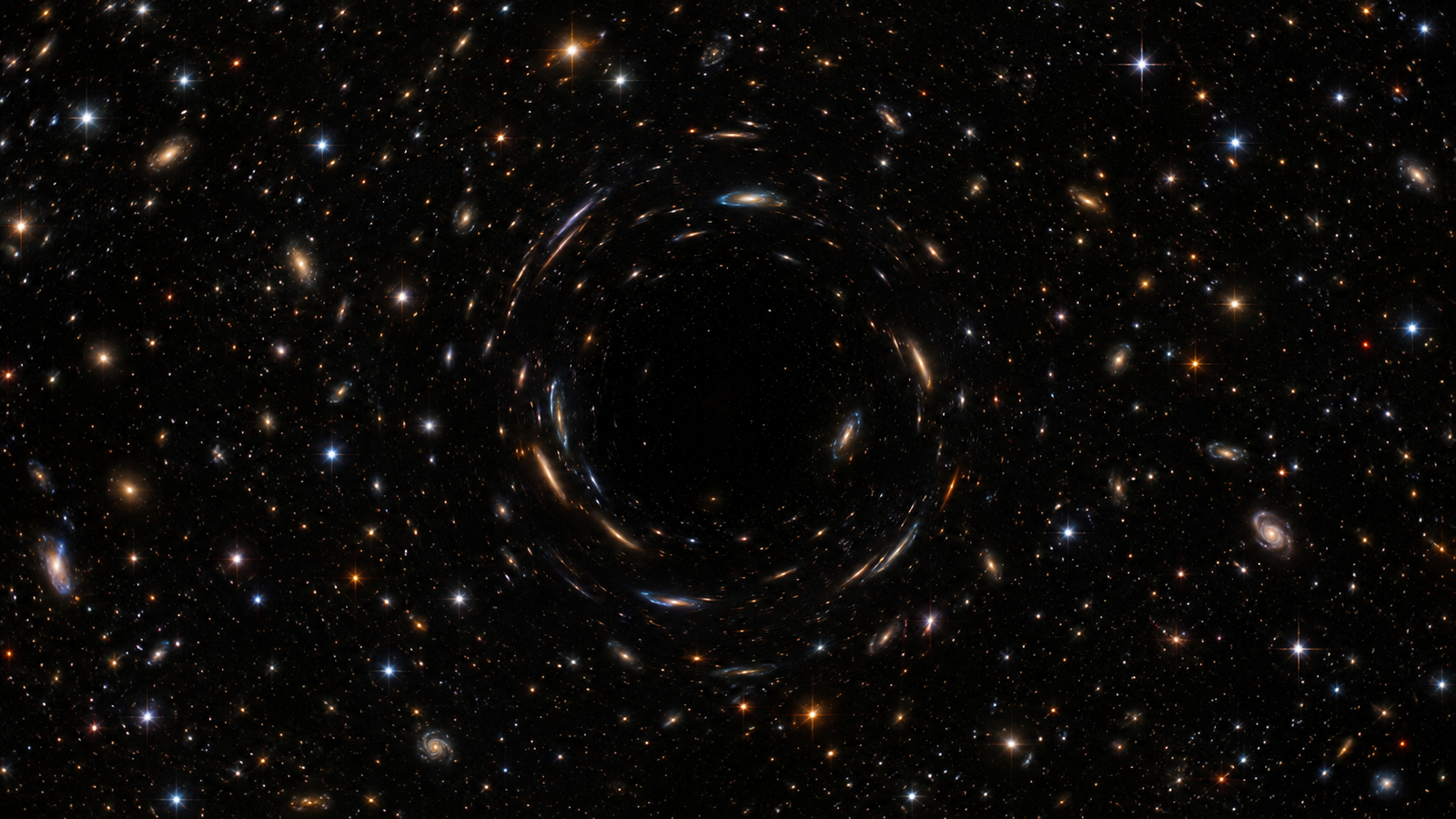
That gravitational pull, arriving from a universe we cannot otherwise observe, is what Kaku has suggested dark matter might actually be. Not an undiscovered particle hiding in our own universe, but the gravitational shadow of ordinary matter existing in a universe right next to ours.
Why this is fascinating, and why it is not settled science
It is worth being direct about where this idea currently stands. Brane cosmology and extra dimensional models are a legitimate, active area of theoretical physics, built on serious mathematics within string theory and M theory. They are not fringe ideas invented for a social media post. But they are also not the accepted explanation for dark matter, and most physicists working in the field would describe this as one interesting hypothesis among several, not a confirmed discovery.
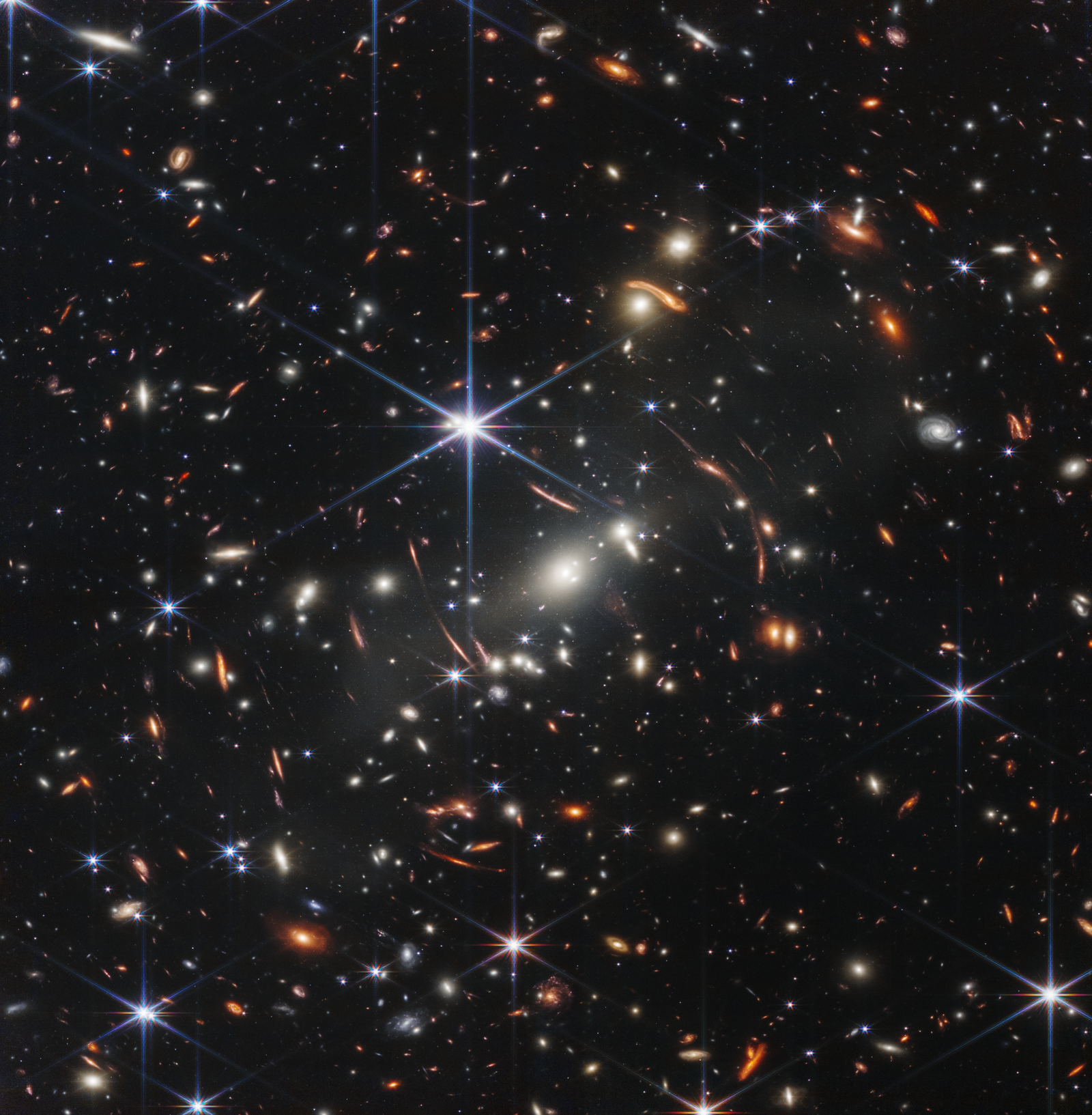
Part of the challenge is that these models are extraordinarily difficult to test. Even the James Webb Space Telescope’s first deep field image of galaxy cluster SMACS 0723, famous for the glowing arcs of warped, lensed light stretched around it, is really a picture of dark matter doing the bending. Webb photographed the visible galaxies. The gravity distorting them belongs almost entirely to matter nobody can see.
Some researchers have pointed out that if regular matter and dark matter show up in roughly the same places throughout the universe, which they generally do, it becomes very difficult to distinguish a parallel universe explanation from a simpler possibility, that our understanding of how gravity itself behaves on galactic scales is incomplete. That alternative, known as Modified Newtonian Dynamics, proposes adjusting the law of gravity itself rather than adding new matter or new universes.
It has largely fallen out of favor since the Bullet Cluster observation, because a pure modification of gravity struggles to explain why the lensing signal in that collision separated so cleanly from the visible gas. But it remains part of the broader conversation, a reminder that dark matter research is still genuinely open territory, not a solved problem waiting for confirmation.
What makes Kaku’s framing worth taking seriously is not that it has been proven. It has not. What makes it worth taking seriously is that it offers a single elegant explanation for two separate mysteries at once, why gravity is so weak, and what dark matter actually is, using mathematics that was developed independently of either question. That kind of unexpected connection is often how real breakthroughs in physics begin, even when the specific idea that sparked them turns out to need major revision. If you want the deeper mechanics behind ideas like this one, our piece on black holes that may be older than the Big Bang explores a similarly unsettled frontier of cosmology.
What it would mean if it is true
Sit with the implication for a moment. If this theory is correct, there is a universe close enough that we feel its gravity every single day, in the way our own galaxy holds together, in the way galaxy clusters bend starlight, in the invisible scaffolding that shaped where every galaxy in the observable universe was allowed to form in the first place. We could never travel there. We could never see it, send a signal to it, or receive one from it. The only evidence it would ever leave behind is the shape of its gravity, stamped across the structure of our own cosmos.
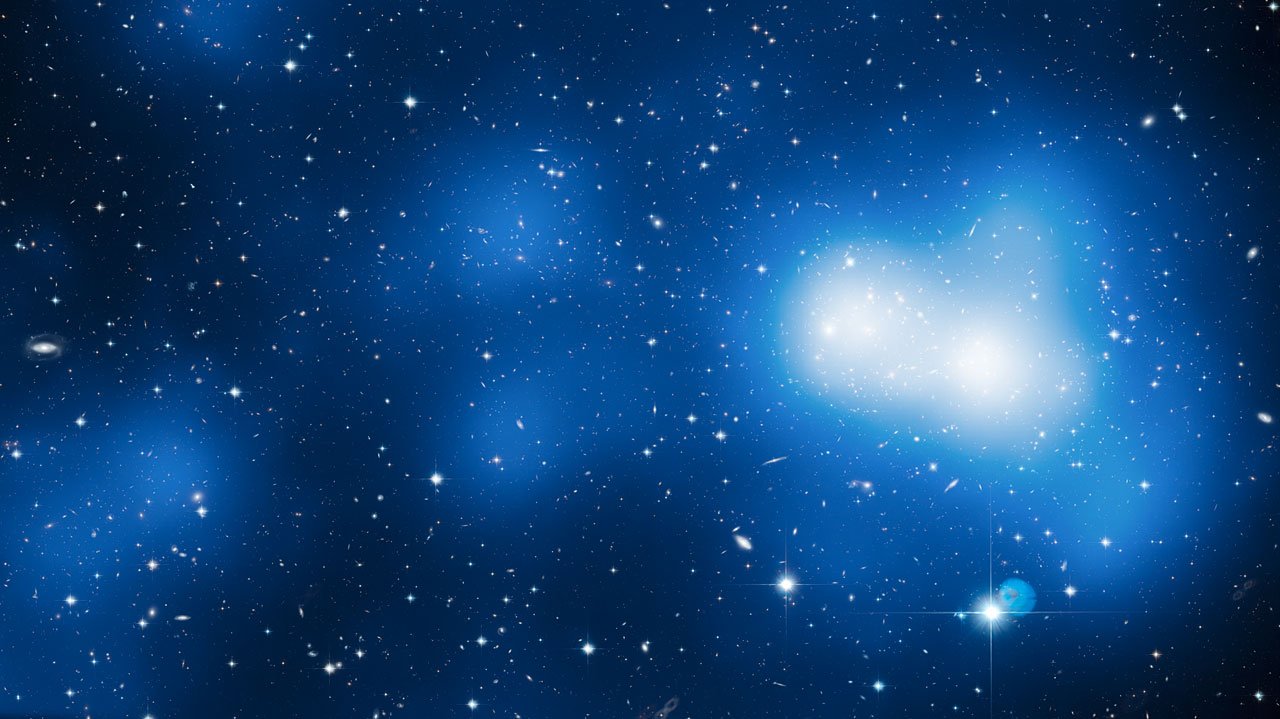
Mapping the distribution of dark matter across the universe, something astronomers are already doing with increasing precision, would then be something far stranger than a map of missing mass. It would be the closest thing humanity has ever produced to a map of another universe, built entirely out of the gravitational echo it leaves behind in ours.
That is the real power of this idea, not that it has been confirmed, but that it reframes a question we thought we understood. Dark matter research has spent decades asking what the missing mass is made of. Kaku’s proposal asks a more unsettling question. What if it was never a question of what, but a question of where.
Interesting Facts
- Dark matter outweighs all the visible matter in the universe, stars, planets, gas, and dust combined, by roughly five to one.
- The first evidence for dark matter was collected in 1933, decades before the term itself became common, when Fritz Zwicky noticed that galaxies in the Coma Cluster were moving far too fast to stay gravitationally bound by their visible mass alone.
- Every major WIMP and axion detection experiment to date, including deep underground detectors shielded from cosmic rays, has returned a negative result.
- String theory’s version of extra dimensions requires eleven total dimensions, only four of which, three of space and one of time, are the ones we directly experience.
- The Bullet Cluster collision is considered one of the strongest pieces of evidence against alternative gravity theories, because it shows the gravitational mass physically separating from the visible gas during a cosmic collision.
- The James Webb Space Telescope’s very first released image, the SMACS 0723 deep field, is itself a dark matter photograph in disguise, since the warped arcs of light in the frame are caused almost entirely by invisible mass.
- Hubble Space Telescope observations have been used to build three dimensional maps of dark matter filaments stretching tens of millions of light years across space.
Frequently Asked Questions
Is dark matter actually proven to exist? The evidence for dark matter’s gravitational effects is extremely strong and comes from multiple independent sources, including galaxy rotation curves, gravitational lensing, and the Bullet Cluster collision. What has not been proven is what dark matter actually is. No particle or direct source has ever been detected.
Did Michio Kaku discover that dark matter comes from a parallel universe? No. This is a theoretical proposal, not a confirmed discovery. Kaku has discussed the idea publicly as one possible explanation drawn from string theory and brane cosmology, but it has not been tested or confirmed, and it is not the consensus explanation among physicists.
Why would gravity be able to cross between universes if nothing else can? In brane cosmology, most particles and forces are thought to be confined to the surface of our universe’s membrane, while gravity, due to the nature of the particle theorized to carry it, is not. This is also the leading explanation in this framework for why gravity is so much weaker than the other fundamental forces.
Could dark matter just be a sign that our understanding of gravity is wrong, instead of a parallel universe or a new particle? That possibility exists and is studied under the name Modified Newtonian Dynamics. It has lost significant support since the Bullet Cluster observation, which showed gravitational mass physically separating from visible matter in a way that a simple modification of gravity struggles to explain.
Has any experiment ever actually detected dark matter directly? No. Every major detection experiment for both leading particle candidates, WIMPs and axions, has returned a negative result as of 2026. Each new result narrows where a particle could be hiding without ever finding one.
Did the James Webb Space Telescope find dark matter? Not directly. Webb has photographed the gravitational lensing effects dark matter causes, most famously in its first released deep field image, but it detects dark matter’s influence through light bending, not the substance itself.
If dark matter is gravity from another universe, could we ever visit it or communicate with it? Based on the theory itself, no. If dark matter is the gravitational effect of matter in a parallel brane, gravity would be the only thing crossing between the two universes. No light, signal, or physical travel would be possible by any mechanism this theory describes.
The Universe Keeps Getting Stranger
If a theory like this can change how you see the night sky, there is a lot more waiting inside From Worlds Beyond. Explore more deep space mysteries, from black holes that may predate the Big Bang to the search for life in the clouds of Venus, and keep following along as the universe keeps revealing just how much we still do not know.