
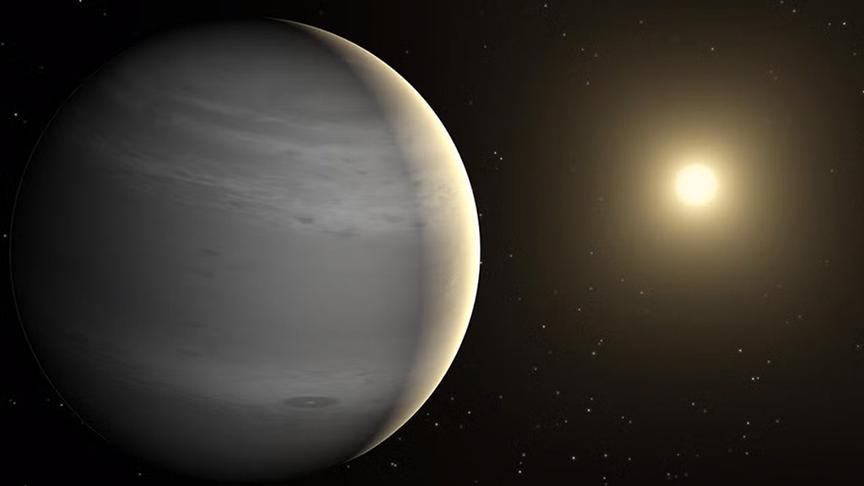
Picture standing on a world the size of Saturn, where the air outside would feel roughly like the inside of a car left in the sun on a hot afternoon. Not comfortable, but not alien either. Warm, familiar, almost forgiving, in a universe that is usually either frozen solid or hot enough to melt iron.
There is nowhere to actually stand. TOI-199b has no surface at all, just a deep, thickening haze of gas that gets denser the further down you go until pressure and temperature blur into something that isn’t really weather anymore. A world with an atmosphere gentle enough to remind you of home, wrapped around the one thing that makes it completely uninhabitable, the fact that it isn’t really a place at all.
That contradiction is exactly why astronomers are so interested in it.
TOI-199b at a Glance
| Feature | TOI-199b |
|---|---|
| Distance from Earth | About 330 light years |
| Size | Roughly the size of Saturn, about 80 percent of Jupiter’s radius |
| Mass | About 17 percent of Jupiter’s mass, roughly half of Saturn’s |
| Orbital period | About 104 days |
| Estimated temperature | Around 175 degrees Fahrenheit, 79 degrees Celsius |
| Atmosphere | Methane confirmed, a likely ammonia signal still being confirmed, no detectable carbon dioxide |
| Discovered by | NASA’s TESS mission, 2018, confirmed 2023 |
| Atmosphere studied by | James Webb Space Telescope, published May 2026 |
| Publishing journal | The Astronomical Journal |
A Planet That Breaks the Usual Rule
A Planet That Breaks the Usual Rule
Almost every giant planet astronomers have found beyond our solar system falls into one of two extremes. There are the hot Jupiters, worlds that orbit so close to their stars that their skies can reach thousands of degrees, hot enough in some cases for iron to exist as a gas. Then there are the cold giants, planets like our own Jupiter and Saturn, sitting so far from their stars that their cloud tops drop to hundreds of degrees below zero.
TOI-199b does neither. It orbits a star more than 330 light years away, completing one lap roughly every 104 days, at a distance that leaves it sitting in an unusual middle ground. Its estimated temperature comes out to around 175 degrees Fahrenheit, hot by human standards, similar to the inside of a car parked in direct summer sunlight, but nowhere near the extremes that define almost every other giant planet ever studied.
“Since the first exoplanet was discovered in 1992 by a team that included Aleksander Wolszczan at Penn State, astronomers have found thousands of exoplanets,” said Renyu Hu, the Penn State astronomer who led the research team behind the new study. “But only a few giant, temperate exoplanets are known, and this is the first time that we have been able to study the atmosphere of one of them in detail.”
That rarity is the whole reason this planet matters. Astronomers have long suspected that temperate gas giants like this one should exist somewhere between the two extremes they already understood well. TOI-199b is the first one anyone has actually been able to study closely enough to find out what its atmosphere is made of.
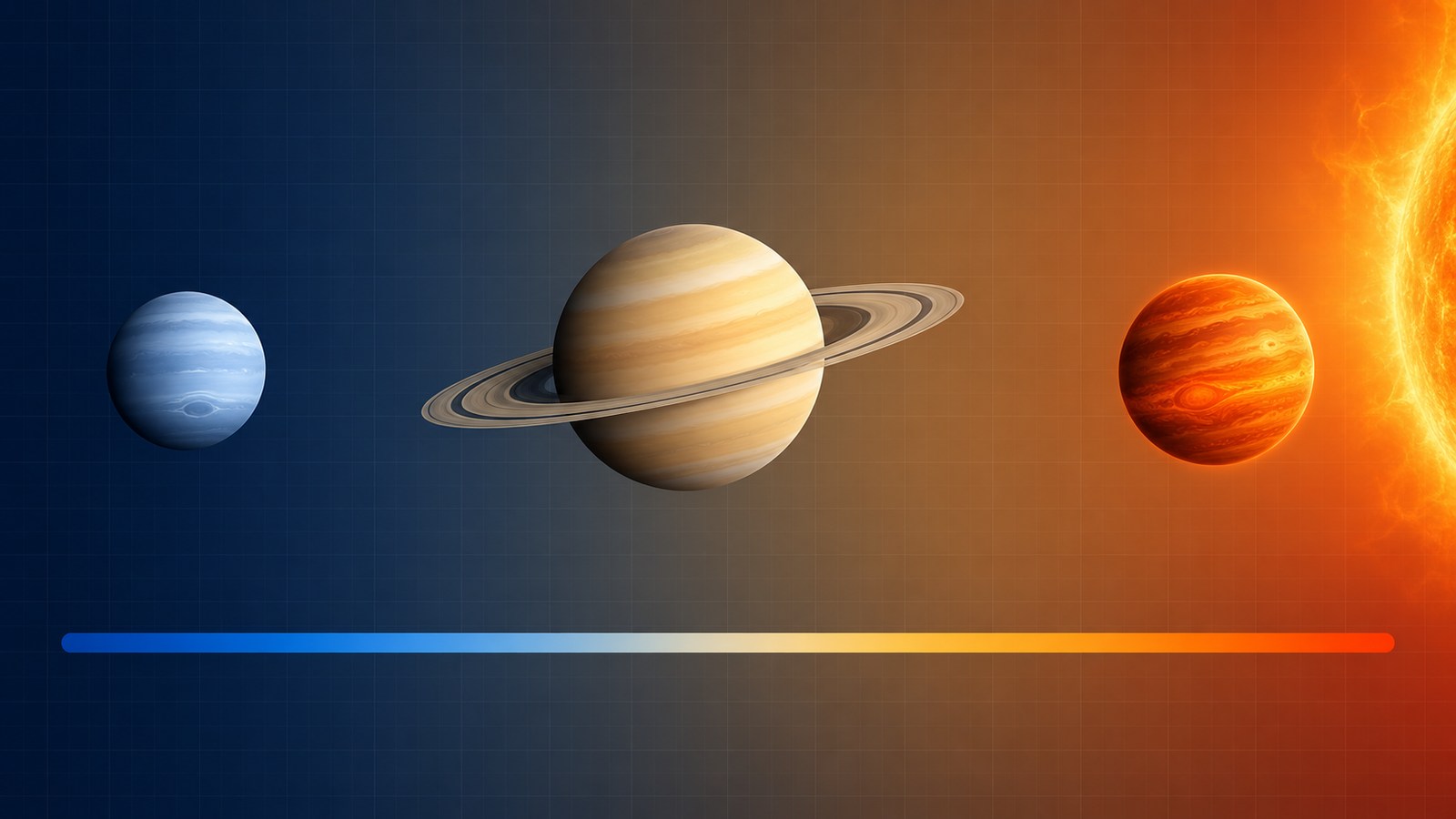 Illustration. Most known giant exoplanets are either scorching hot Jupiters or frozen cold giants. TOI-199b sits in the rare temperate zone between them.
How Scientists Actually Read an Atmosphere From 330 Light Years Away
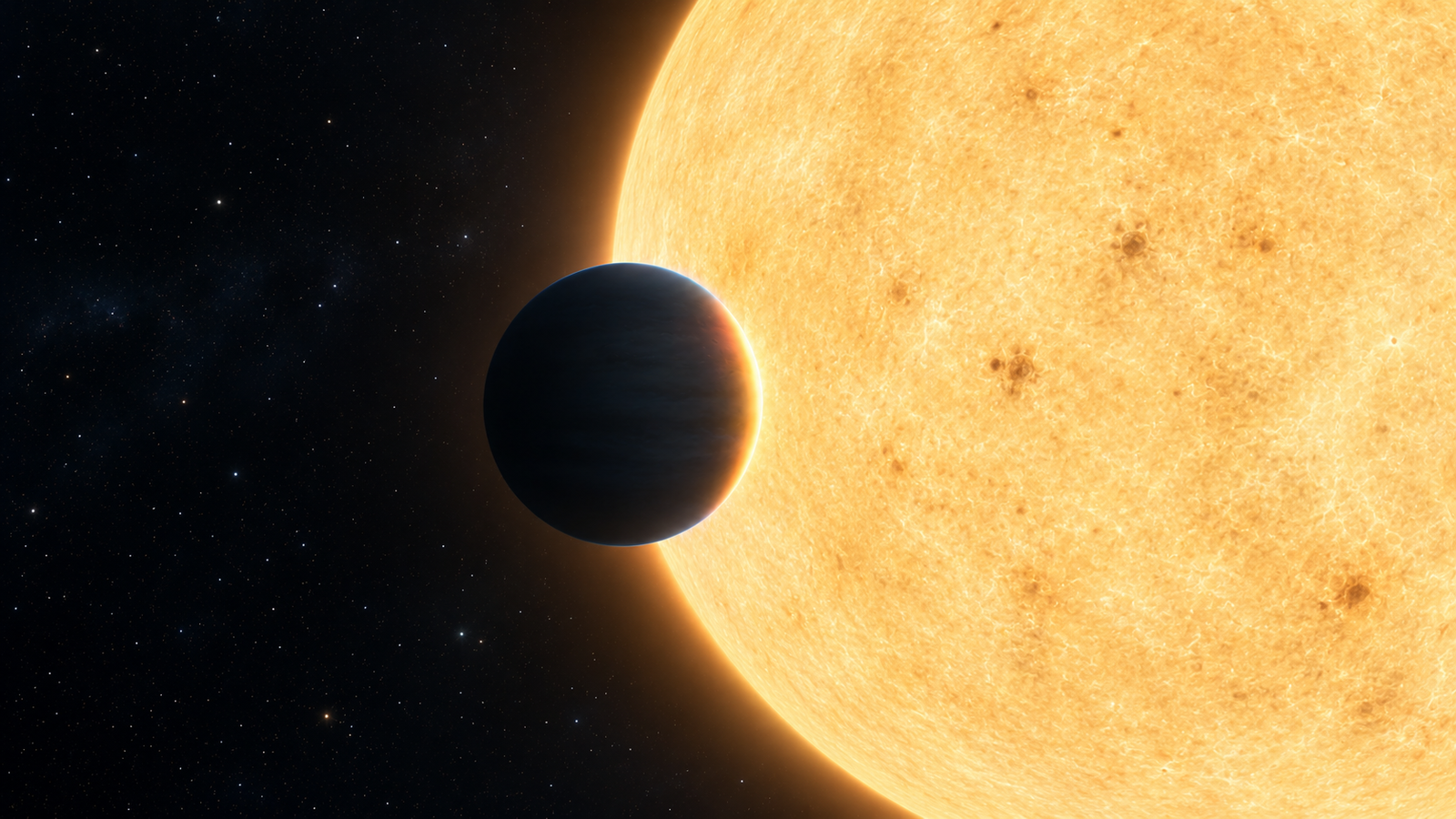
None of this came from a photograph. To study TOI-199b’s atmosphere, the research team, led by Aaron Bello-Arufe at NASA’s Jet Propulsion Laboratory, used a method called transmission spectroscopy. As the planet passes directly in front of its star from Webb’s point of view, a sliver of the star’s light filters through the planet’s atmosphere on its way to the telescope. Different molecules in that atmosphere absorb very specific wavelengths of light as it passes through, leaving a kind of chemical fingerprint behind in the spectrum Webb detects.
“As a planet passes in front of its star, some of the star’s light passes through the planet’s atmosphere where it interacts with the elements and molecules in the atmosphere,” Bello-Arufe explained. “Specific elements will absorb specific wavelengths of light, creating a fingerprint in the spectrum of light that JWST detects that reflects the atmosphere’s composition.”
The transit itself lasted about seven hours, much longer than the transits of hot Jupiters, which can be over in an hour or less, since TOI-199b orbits so much farther from its star. Researchers compared that transit spectrum against roughly twenty hours of baseline observations of the star’s ordinary light, then looked for the gaps where TOI-199b’s atmosphere had quietly absorbed specific wavelengths on the way past, detail later laid out in full in the team’s peer reviewed paper.
What they found was methane, detected with strong confidence. “When we compared the spectra during the transit to the baseline, we saw that the atmosphere blocked the wavelengths of starlight absorbed by methane,” Bello-Arufe said. “Models for the composition of temperate, gas giant exoplanets had predicted that they would contain methane, so it is good to get confirmation that our theories are accurate.”
The spectrum also showed a separate signal that the team attributes most likely to ammonia, though a less probable alternative, a compound called hydrogen cyanide, has not been ruled out. Carbon dioxide, notably, was not detected with any real confidence, and its absence actually helped the team narrow down what the atmosphere’s broader chemistry is unlikely to look like. More observations will be needed to settle the ammonia question for good.
A Familiar Temperature on a World With Nowhere to Stand
This is the part worth sitting with. TOI-199b’s temperature genuinely overlaps with conditions found on Earth. But TOI-199b is not a rocky planet with a surface underneath an atmosphere the way Earth is. It is a gas giant, built mostly of hydrogen and helium wrapped around what researchers believe is a dense core of ice and rock buried far below any pressure a spacecraft, let alone a person, could survive.
There is no ground to land on, no ocean to float in, no boundary where atmosphere ends and solid world begins. The mild temperature that makes this planet so scientifically interesting exists only in a thin band of its outer atmosphere, the same layer Webb was able to read starlight through. Descend any further and both pressure and heat climb far beyond anything survivable, long before you would ever reach whatever lies at the center.
It is a useful reminder for anything described as “Earth-like” in space coverage generally. A temperature alone does not make a world hospitable. What matters just as much is what that world is actually made of, and TOI-199b, for all its mild weather, is not built anything like home.
Interestingly, TOI-199b does not appear to be alone in its system. Follow up analysis of its orbit has turned up evidence of a second, non-transiting giant planet further out, one whose gravity is subtly tugging on TOI-199b’s own orbital timing. Early estimates place that outer planet within its star’s conservative habitable zone as well, though it too appears to be a giant world rather than anything rocky, so the same basic problem applies there.
Why This Discovery Matters Beyond One Planet
Temperate gas giants like TOI-199b have been a genuine blind spot in exoplanet science, not because they are rare in nature, but because they are hard to study. Hot Jupiters are bright, close to their stars, and transit quickly and often, making them convenient targets. Cold giants like Jupiter and Saturn are only well understood because we happen to live next door to them. The temperate middle ground has mostly been theoretical, modeled on paper rather than observed directly.
“With additional observations of this planet, we could establish the relative abundance of these various gases in its atmosphere,” Hu said. “This more complete picture of a temperate gas giant’s atmosphere can then be used to improve our models and potentially better understand how planets and their atmospheres form and evolve, including for Earth.
The success of this first study of a temperate giant planet’s atmosphere also gives us confidence to dedicate more resources and observation time to study other similar planets. We can then see if this planet is unique or if there are general shared characteristics for this type of planet.”
That last point is the real significance here. TOI-199b is not just one strange planet. It is a proof of concept, evidence that an entire category of worlds sitting between the two extremes astronomers already knew well can actually be studied in detail. What gets learned from this one planet’s methane, and from the still unresolved signal that may turn out to be ammonia, will likely shape how the next several temperate giants get read the moment Webb turns toward them.
What Else Is Hiding in the Middle Ground?
The honest answer is that nobody knows yet how common planets like TOI-199b actually are. It took until 2026 to get a detailed look at the atmosphere of even one. As Webb continues studying other temperate giants, part of what researchers are hoping to learn is whether TOI-199b’s methane rich, faintly hazy atmosphere is typical of this entire category of world, or whether it turns out to be its own unusual case.
Distinguishing between those two outcomes will likely take years, the same patient, multi mission approach that gradually built our current understanding of Venus’s own runaway atmosphere, where a single close look was never going to be enough on its own.
Frequently Asked Questions
What is TOI-199b? A Saturn sized gas giant exoplanet located about 330 light years from Earth, notable for having an atmospheric temperature close to Earth’s own, unusually mild for a planet of its size.
Could TOI-199b support life? No. Despite its mild temperature, TOI-199b is a gas giant with no solid surface, built mainly of hydrogen and helium around a dense core. Life as we understand it needs a surface or a stable boundary to exist on, which this planet does not have.
How did scientists figure out its temperature and atmosphere without a photograph? Using a technique called transmission spectroscopy. As TOI-199b passed in front of its star, the James Webb Space Telescope analyzed how starlight changed after filtering through the planet’s atmosphere, revealing which molecules were present.
What makes TOI-199b different from a hot Jupiter? Hot Jupiters orbit extremely close to their stars and can reach thousands of degrees. TOI-199b orbits much farther out, giving it a far milder, more Earth-comparable temperature instead.
Why haven’t astronomers studied planets like this before? Temperate gas giants are difficult targets. Hot Jupiters are bright and transit frequently, making them convenient to observe, while cold giants like Jupiter and Saturn are only well understood because they are in our own solar system. Planets in between have mostly been theoretical until now.
Is there another planet in the TOI-199 system? Evidence suggests a second, non-transiting giant planet also orbits the same star further out, subtly affecting TOI-199b’s orbital timing. It also appears to be a gas giant rather than a rocky world.
Will scientists learn more about TOI-199b in the future? Yes. Researchers have said additional observations are needed to confirm whether a separate signal in the data is really ammonia, and further study should help determine whether this planet’s atmosphere is typical of temperate gas giants in general.
The Universe Keeps Blurring Its Own Categories
For years, giant exoplanets fell neatly into two boxes, scorching or frozen, with nothing much expected in between. TOI-199b just proved that assumption wrong, and it is very unlikely to be the only planet quietly sitting in the space nobody thought to look. If worlds like this pull you in, worlds that almost make sense until you look closer, explore more discoveries from beyond our solar system, where the next planet that shouldn’t exist is probably already sitting in someone’s data.