
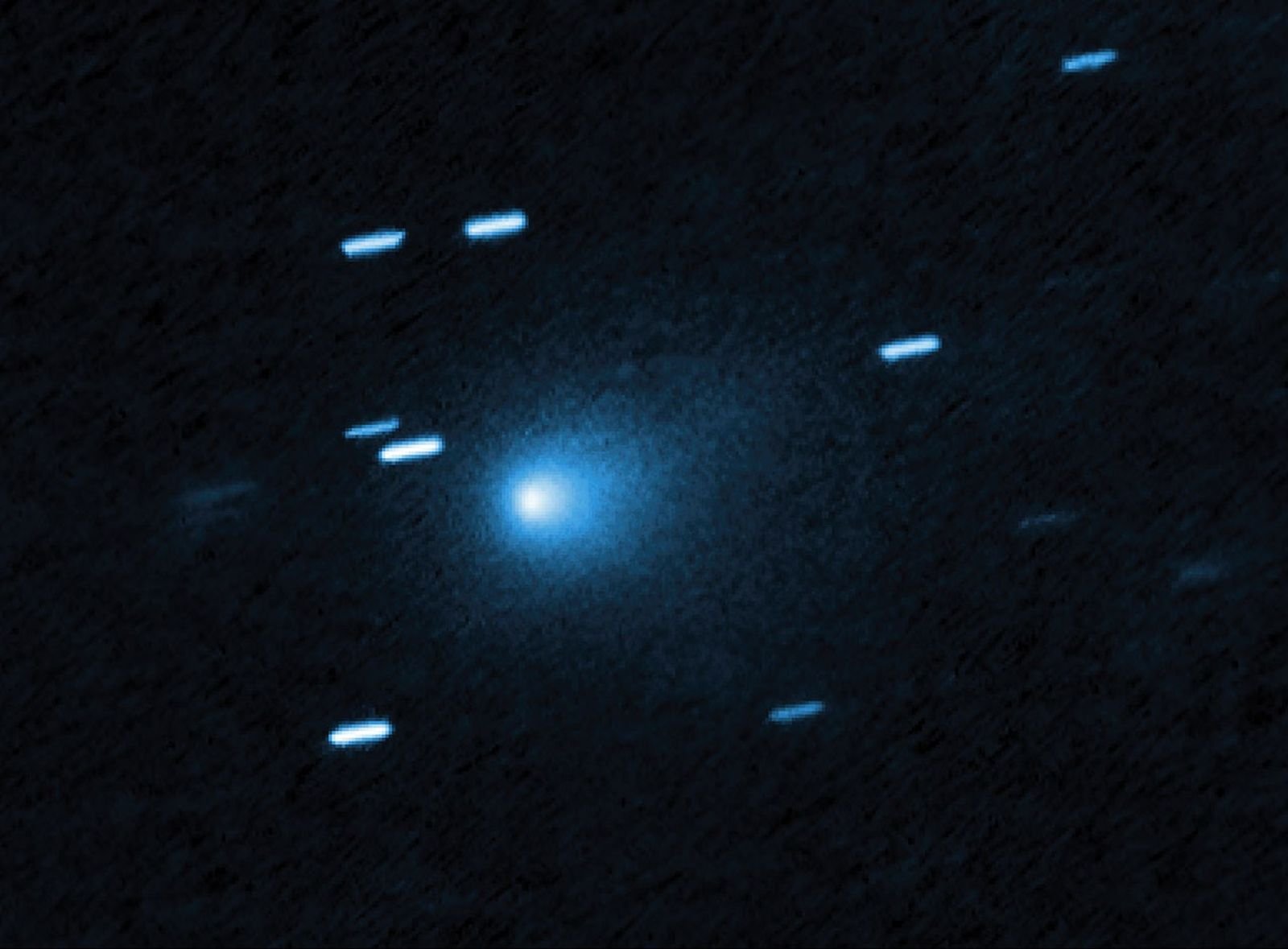
Seven billion years before the Sun ignited, before Earth was even dust scattered across a forming disk of gas, something was already drifting through the galaxy. That fragment of ancient ice and rock is now known as the 3I/ATLAS interstellar comet, sealed shut around chemistry from a star that died long before ours was born. It has just crossed through our solar system, and for a few short months in 2025 and 2026, humanity’s most powerful telescopes turned to watch it pass.
Its name is 3I/ATLAS. It is the third confirmed visitor our solar system has ever received from interstellar space, and it may be the oldest comet ever observed by human eyes.
The 3I/ATLAS Interstellar Comet, Explained
3I/ATLAS is an interstellar comet discovered on July 1, 2025, by the ATLAS survey telescope in Chile. It did not form in our solar system. Its steep, one way trajectory through the Sun’s gravity confirms it arrived from another star system entirely, and multiple independent studies estimate its age at roughly seven billion years, with some newer research suggesting it could be even older. It poses no danger to Earth.
A Visitor With No Way Home
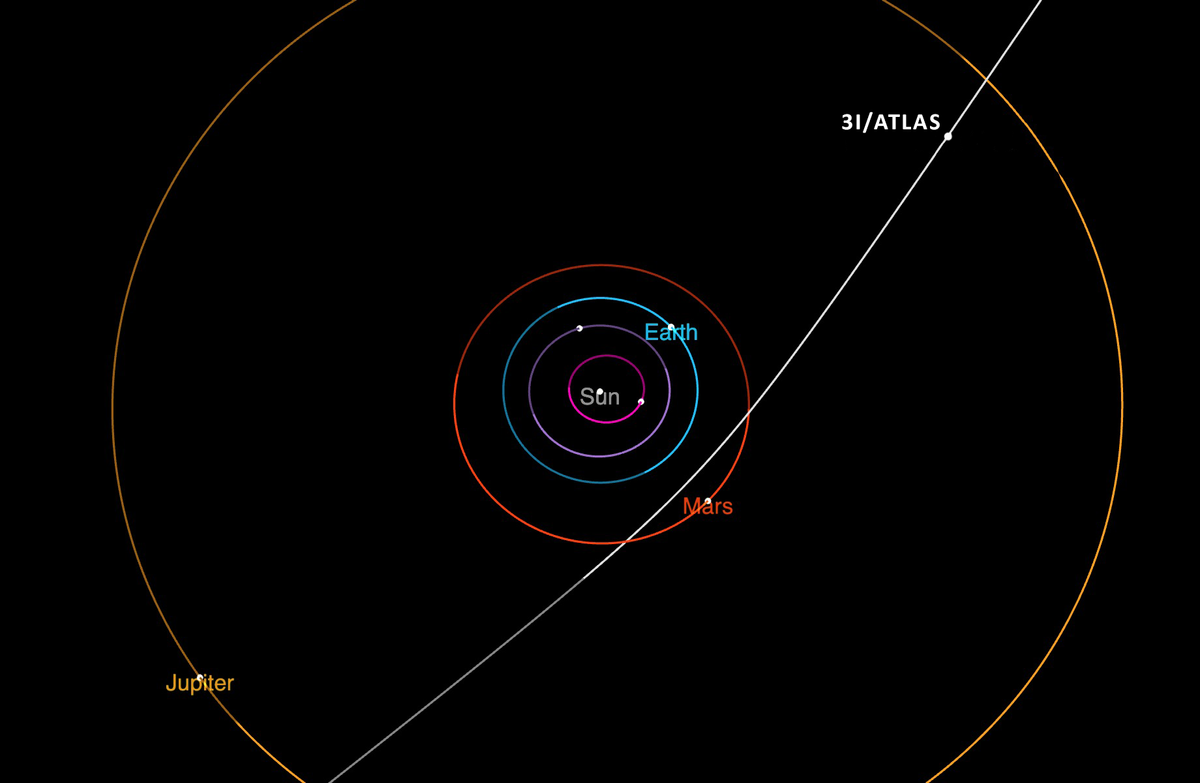
Every comet you have ever heard of, Halley’s Comet included, was born alongside our Sun about four and a half billion years ago. They orbit the Sun in loops, appearing and vanishing on a schedule. The 3I/ATLAS interstellar comet does not do this. Its path is hyperbolic, a wide open arc rather than a closed loop, which means it was never captured by the Sun’s gravity at all. It simply passed through, the way a stranger walks through a room without ever intending to stay.
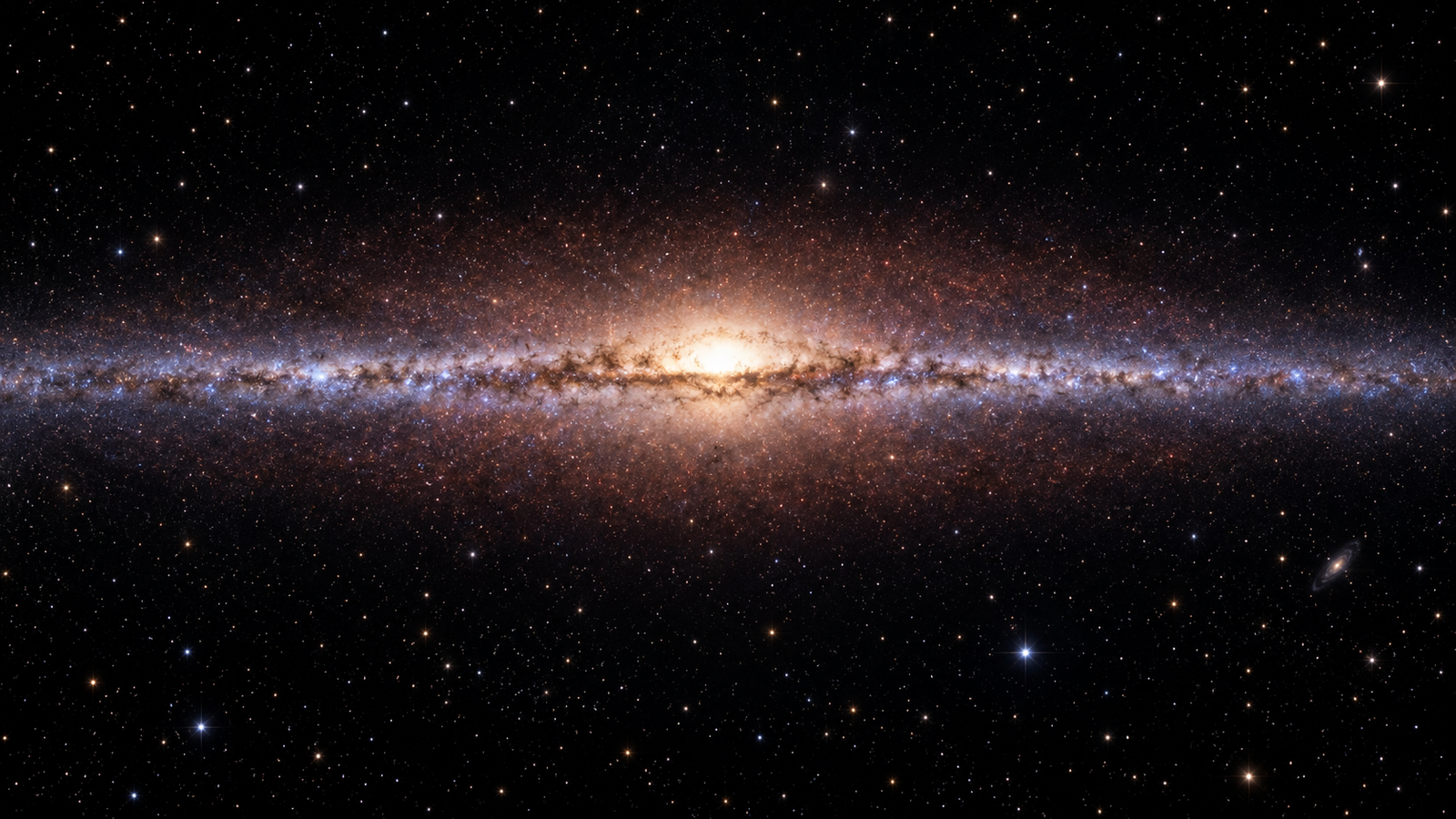
When astronomers traced that arc backward across the sky, they found something remarkable. The comet’s trajectory pointed toward the thick disk of the Milky Way, an ancient region of the galaxy sitting above and below the flatter disk where our Sun resides. Stars in the thick disk are old in the deepest sense, many of them ignited within the first few billion years after the galaxy itself formed. If 3I/ATLAS condensed alongside one of those stars, its age would be tied to theirs.
A team from the University of Oxford calculated the odds. Their statistical best estimate placed the comet at approximately seven billion years old, with roughly a two in three chance that it predates our entire solar system. Later that year, the European Southern Observatory’s Very Large Telescope measured the ratios of carbon and nitrogen isotopes locked inside the comet’s gas cloud, chemical fingerprints that survive largely unchanged across billions of years of interstellar travel. Three independent measurements converged on the same conclusion. The comet’s chemistry does not match anything born in our solar system.
Since then, one newer study using a different modeling approach has pushed the estimate even higher, suggesting an age closer to ten or twelve billion years, old enough to rival the Milky Way itself. That figure has not yet reached the same level of scientific consensus as the seven billion year estimate. It is a live, ongoing debate rather than settled fact, and that distinction matters. What every study agrees on is this: 3I/ATLAS is older than the Sun, older than Earth, older than anything else that has passed close enough for us to study directly, including our own planet’s fragile, everyday physics.
What It Is Actually Made Of
3I/ATLAS is not a rock. It is an active comet, meaning it has an icy nucleus that releases gas and dust as sunlight warms it, forming a glowing coma and a faint tail. Hubble Space Telescope observations placed its nucleus somewhere between 440 meters and 5.6 kilometers across, and later refinements using James Webb Space Telescope data suggested an effective diameter closer to 2.6 kilometers, making it noticeably larger and more massive than the second known interstellar visitor, comet 2I/Borisov.
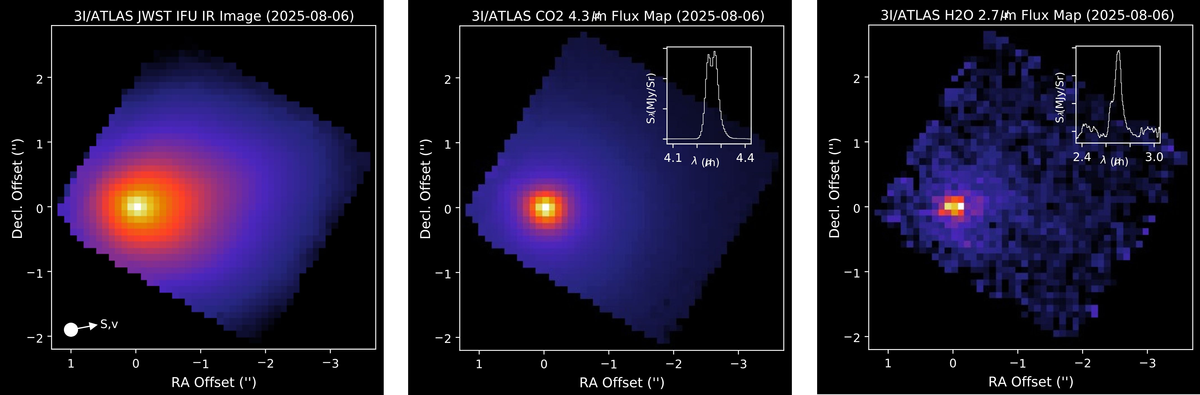
When JWST examined the light coming from the comet’s coma, it found carbon dioxide, water ice, carbon monoxide, and methane, an unusually volatile ice that only survives at extremely low temperatures. X-ray telescopes later detected a faint glow surrounding the nucleus, making 3I/ATLAS the first interstellar comet ever observed in X-ray light. Every instrument turned toward it added another layer to a chemical record that formed long before our own planetary system existed.
Is 3I/ATLAS Dangerous
3I/ATLAS came no closer to Earth than about 270 million kilometers, roughly 1.8 times the distance between Earth and the Sun. NASA, ESA, and every planetary defense agency tracking its orbit confirmed there was never any risk of collision.
That has not stopped speculation. Harvard astrophysicist Avi Loeb publicly raised the possibility that some of the comet’s behavior could hint at an artificial origin, a claim that spread quickly online and fed viral rumors of an alien probe.
What About the Alien Theory
It is worth being direct about where the science actually stands. The overwhelming consensus among astronomers, backed by direct spectroscopic evidence of ice sublimation, gas jets, and a genuine cometary coma, is that 3I/ATLAS is a completely natural object. The artificial origin idea remains an unproven, minority hypothesis, not a competing scientific finding.
Where 3I/ATLAS Is Now
The comet reached its closest approach to the Sun on October 30, 2025, passing just inside the orbit of Mars before curving back outward. It swept past Jupiter’s orbital distance in early 2026 and is now speeding back into interstellar space, never to return. Astronomers had a matter of months to study a fragment of another star system up close. They will likely never get the chance to study this particular object again.
Interesting Facts
- 3I/ATLAS was moving at close to 137,000 miles per hour when it was first discovered, and accelerated to roughly 153,000 miles per hour at its closest approach to the Sun, faster than either of the two previous interstellar visitors, Oumuamua and Borisov.
- Nearly every major mission NASA and ESA had pointed at the inner solar system took a look, including Hubble, JWST, the Parker Solar Probe, the Lucy and Psyche asteroid missions, the Perseverance rover on Mars, and ESA’s Mars Express and ExoMars orbiters.
- Astronomers estimate that an interstellar object this large or larger passes through the inner solar system roughly once every five to ten years. Most are simply too faint to detect with current technology.
FAQ
How old is the 3I/ATLAS interstellar comet? Most current research places its age at approximately seven billion years, based on its likely origin in the Milky Way’s ancient thick disk. That would make it roughly three billion years older than our solar system. A newer, less established study suggests it could be even older, but that estimate is still under scientific debate.
Is 3I/ATLAS dangerous? No. Its closest approach to Earth was about 270 million kilometers away, and its trajectory has been tracked and confirmed safe by NASA and ESA.
Where did 3I/ATLAS come from? Its trajectory traces back to the thick disk of the Milky Way galaxy, an ancient region far from where our Sun formed. It is not native to our solar system and will never return.
Is 3I/ATLAS an alien spacecraft? No credible scientific evidence supports that idea. Direct observations of ice sublimation, gas jets, and a natural cometary coma confirm it behaves exactly as a comet should. The artificial origin theory remains an unproven, fringe hypothesis.
Will we ever see 3I/ATLAS again? No. Its hyperbolic trajectory means it is leaving the solar system permanently and will never return.
Conclusion
The 3I/ATLAS interstellar comet spent seven billion years crossing the galaxy before it ever caught the light of our Sun. For a brief window, it became the most closely watched object in the sky, studied by nearly every telescope humanity has pointed at the heavens. Then it kept moving, the same way it always has, carrying chemistry from a star system that no longer exists into a darkness we will never follow it into. It came from nowhere we know, and it is going somewhere we will never see.
The Next Wanderer Is Out There
If the story of an ancient wanderer crossing our solar system caught your attention, there is more where that came from. Explore more deep space stories on the From Worlds Beyond YouTube channel, and keep discovering the universe here on the blog.